Film Review
Backrooms
Chiwetel Ejiofor · Renate Reinsve · Finn Bennett
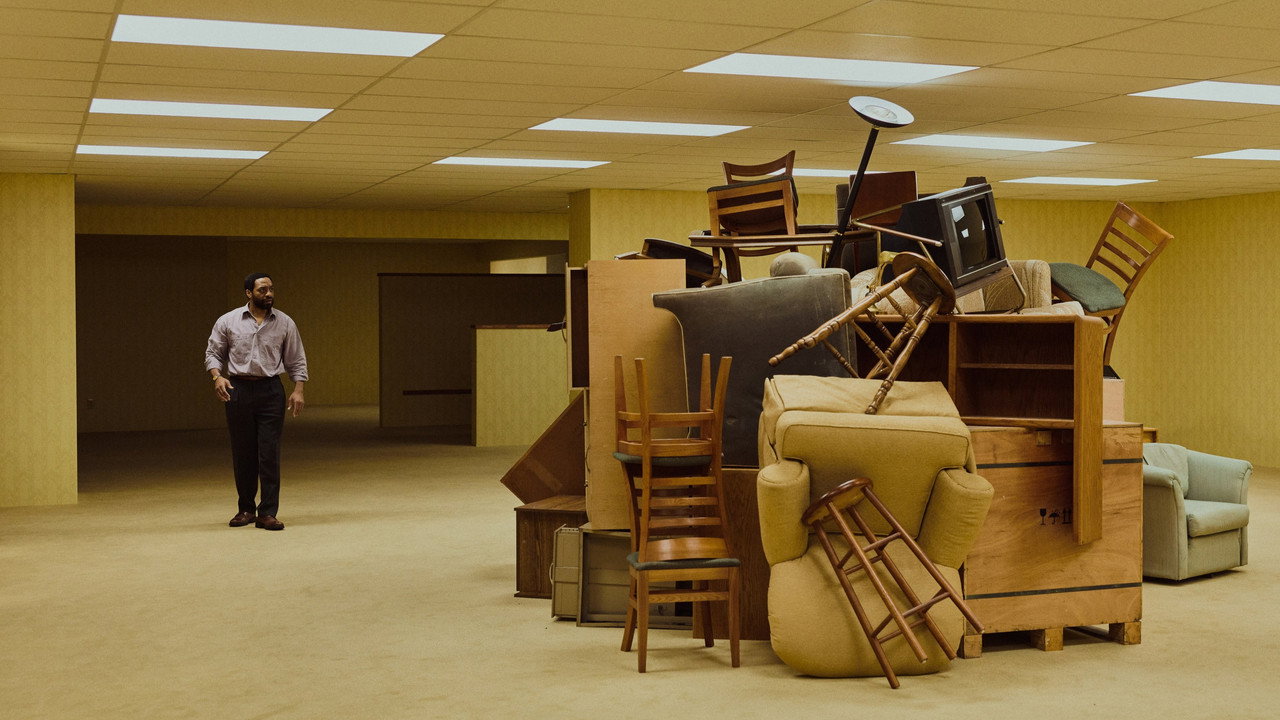
The most frightening thing Kane Parsons does in Backrooms is refuse, for as long as he can, to shoot the space like a horror set. His governing instinct is to withhold the visual menace we brace for. The dread here is architectural. It comes from the endlessness of the yellow rooms, the buzz of overhead fluorescents, the faint moan that could be a voice or a duct. A wide angle keeps stretching the hallways past any believable depth; a fish-eye distends them until the geometry itself feels hostile. The horror is in the context and the extrapolation, not in anything lunging at the frame.
Editorial Deep
Score breakdown, defended
Each dimension scores what it scores. The number is the claim; the prose is the defense.
Editorial Layer
Flat mean of the five dimensions below. Contributes 71% to the Skry Score.
The screenplay commits to an open, near-plotless structure suited to liminal-space horror, and its central allegory of a man who refuses accountability is dramatized cleanly in the dinner scene and paid off physically in the escape through a passage too narrow for the creature. That is coherent design. The limitation is real and structural: characterization leans almost entirely on trauma, the ending arrives abruptly, and the late rule that a character can exit and re-enter the space undercuts the inescapability the premise depends on. The film asks better questions than it answers, and whether that reads as intention or thinness is a genuine split the writing does not fully resolve.
The image is the film's command performance. Cox oscillates between VCR-degraded found footage and clean traditional coverage, and the seam between the two modes is where the dread lives. Wide angles and a fish-eye distend the geometry until the space itself feels hostile, while Vermette's distinct room designs across thirty thousand square feet of built stage keep the labyrinth endless rather than repetitive. The opening corridor sequence achieves fear through restraint, refusing the horror-set grammar entirely. This is a debut with a fully formed visual argument, executed with unusual confidence.
Both leads carry the film on expression and body language, selling wonder and isolated dread with minimal dialogue. Reinsve's physical work in her first horror feature is precise and controlled, a register she hadn't shown before. Ejiofor commits fully to a portrait of a man calcifying against change, and the kitchen scene gives that refusal genuine dimension. The limitation is that the writing hands the supporting ensemble very little, leaving Maxwell and Bennett underused in exactly the found-footage scenes where the cast is strongest, and the fit of the central role remains contestable.
The film moves on dread rather than incident, and for long stretches the rhythm holds: the alternation of degraded and clean image, the buzz-and-moan soundscape, the slow stretching of space all sustain tension without jump-scare crutches. The peak second-act passage lands as sustained unease. The momentum falters in the final act, where the shift to a visible CGI creature deflates the withholding the film built its feeling on, and the abrupt close cuts the tension rather than resolving it.
There is real architecture to return to. The handprint escape reads as the whole film compressed into one image, the dinner scene rewards a second look as the movie's stated thesis, and the sound design carries detail that a first, tense pass will miss. The allegory of refused accountability structures scenes that initially read as pure atmosphere. What caps the return value is the openness cutting both ways: the ambiguity that intrigues on first watch offers less new architecture to excavate than a denser script would.
Parsons' surest instinct is refusal: he shoots the Backrooms as if it were nothing, and the nothing is what frightens you.
That conviction is announced in the opening minutes, a found-footage passage laid over VCR crackle in which a single figure moves down a skinny corridor toward sounds that shouldn't be there. It is among the most effective horror filmmaking of the year, and it works precisely because it looks like nothing. No music cue tells you when to flinch. The film then oscillates between that degraded video texture and cleaner, traditional coverage, a rhythm that lets Jeremy Cox show off the thirty thousand square feet of built stages without ever letting the space feel safe. Danny Vermette's production design gives each room a distinct layout and decor, so the labyrinth reads as endless rather than repetitive. You never quite orient yourself, and that is the point.
The sound work carries as much of the load as the image. Battaglia and Hetmer build dread out of ambience: clipped audio, echoed moans, the electrical hum of a building that has no exterior. This is closer to early Lynch's fixation on industrial noise and the menace of electricity than to the jump-scare grammar the marketing might imply. There is a wizardry to the mood, and it is the film's surest achievement.
As the leads, Chiwetel Ejiofor and Renate Reinsve sell wonder, curiosity, and isolated dread largely through expression and body language. Reinsve, in her first horror feature, does striking physical work: the facial tics, the way her composure fractures on a frightful turn. Ejiofor plays the more extroverted register, the character whose choices bend the story, and he leans into a portrait of a man refusing to change. Whether that refusal lands as a performance of controlled menace or as a slightly ill-fitting role is a question I'll take up on the other side of the spoiler line.
What's harder to adjudicate spoiler-free is the plot. Backrooms is built loose and open, more atmosphere than mechanism, and reasonable viewers split hard on whether that openness is a virtue. One camp finds the questions the film asks more memorable than any answer it offers. The other finds the story thin, the characters sketched only through trauma, and the ending abrupt in a way that frustrates rather than lingers. Both readings are watching the same film honestly. The gap between them is roughly the gap between the critical warmth and the cooler audience response.
As a debut, though, the command of tone is not in dispute. Parsons has made something that casts a genuine spell, and he has done it by trusting silence, space, and sound over spectacle. That is a rare instinct in a first feature, and it is worth two hours of your attention even if you come out arguing.
Beyond this line, spoilers
The Conversation
First-person welcome. Pushing back on consensus is a tool, not a formula.
Everything here is open, so let's talk about the parts I had to walk around above.
I keep coming back to the concrete handprint. The climactic chase ends with Mary beating the Captain Clark entity back using a handprint relic from her childhood home, then slipping down a passage too narrow for the creature to follow. That's the film's thesis made physical, and I think it's the cleanest thing in the movie: the escape route is a piece of who she was before, and the monster is too big with itself to fit through it. When Backrooms trusts its images to carry the meaning, it's genuinely arresting.
The dinner scene is where the allegory turns explicit, maybe too explicit. Mary finally drops her therapeutic 'unconditional positive regard' and tells Clark that nothing is ever his fault, that he blames his brain, that he IS his brain. From there Clark's refusal to change delivers him straight into the maw of a monstrous version of his own store mascot. As a piece of writing it's satisfyingly cruel. As a piece of engineering it's a little on the nose, the movie explaining its own machinery aloud right before it dramatizes it. I don't fully mind. I do notice.
Ejiofor is the flashpoint, and I want to be fair to both sides because I feel both. The case for him is the kitchen scene, where Clark reveals how far he'll go to keep absolute control; it's a portrait of negative character growth, of a man calcifying, and there are levels to it the film would sorely miss with a lesser actor. The case against is that the accent never fully settles and the part fits him strangely. My honest read is that he's doing something interesting inside a role that may have been miscast, and both things can be true at once.
Reinsve I'm more settled on. Some felt the role didn't reach her ceiling, and I understand the disappointment given what she's capable of, but the physical performance is real. The scream-queen register isn't a step down for her; it's a muscle she hadn't shown before, and she's precise with it.
The real structural argument is about the last act. The CGI creature in the climax is, for me, the film's biggest gamble and its biggest risk. The whole picture has spent its capital on withholding, on infrastructural dread, and then it shows you the thing. There's a reading where that literalization deflates the mystery the movie worked so hard to cultivate. There's also the complaint that Clark being able to leave and re-enter the Backrooms at will punctures the inescapability that makes liminal-space horror frightening in the first place. I think that objection has teeth. The concept's power is that there's no door. Give the character a door and you've lowered the ceiling on your own fear.
And yet. The ensemble's strongest tension comes in the found-footage stretches where Clark explores alongside Kat and Bobby, and it's a shame Lukita Maxwell and Finn Bennett aren't given more, because those scenes are where the film's two modes fuse best: the degraded image, the built space, the actors improvising survival. I wanted a whole film pitched at that frequency.
Context matters for how you grade this. Parsons is twenty, the youngest director to helm an A24 feature, and he came up building the Backrooms mythology on YouTube before anyone handed him thirty thousand square feet of stage and producers like Wan and Perkins. The prediction, years ago, was that this material would curdle into a slick, dismal Hollywood product the way Slender Man did. It didn't. That's not nothing. Whether Backrooms is a fully realized film or the most promising thing in its subgenre pointing at what its director will build next, I lean toward the latter, and I mean it as praise. I'd rather watch a first feature that overreaches on tone than one that plays it safe. This one reaches, spends, and mostly wins.
Cast & Crew
Who made it, and who’s in it.
Cast
Chiwetel Ejiofor
Clark

Renate Reinsve
Mary

Finn Bennett
Bobby

Lukita Maxwell
Kat
Mark Duplass
Phil

Avan Jogia
Naren Warne

Robert Bobroczkyi
Pirate Clark

Ember Ambrose
Young Mary

Krista Kosonen
Nora
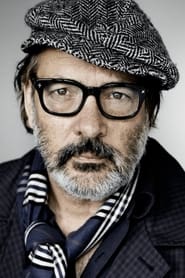
Philip Granger
Meterman

Katharine Isabelle
Robin
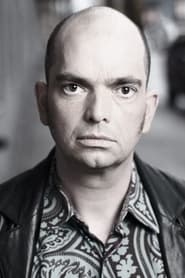
Peter New
Big Wayne
Crew
- DirectorKane Parsons
- WriterWill Soodik
- Director of PhotographyJeremy Cox
- EditorGreg Ng
- Original Music ComposerEdo van Breemen
Trailer
Plays on YouTube, in a new tab.
 Official Trailer · 2026Watch on YouTube
 Reader response
About the Editor
Derik Silva
Editor-in-Chief
Derik founded The Skry to do for film and television what aggregator culture stopped doing — read closely, score honestly, and defend the score in writing. He believes the long arc is the only arc that matters: the films that earn their reputation by holding up over years, and the ones whose reputations have grown larger than the films can carry. Previously, he founded Travault.
The Skry Dispatch
Read closely, weekly. Reviews and dispatches from The Skry.