Film Review
The Super Mario Galaxy Movie
Chris Pratt · Anya Taylor-Joy · Charlie Day
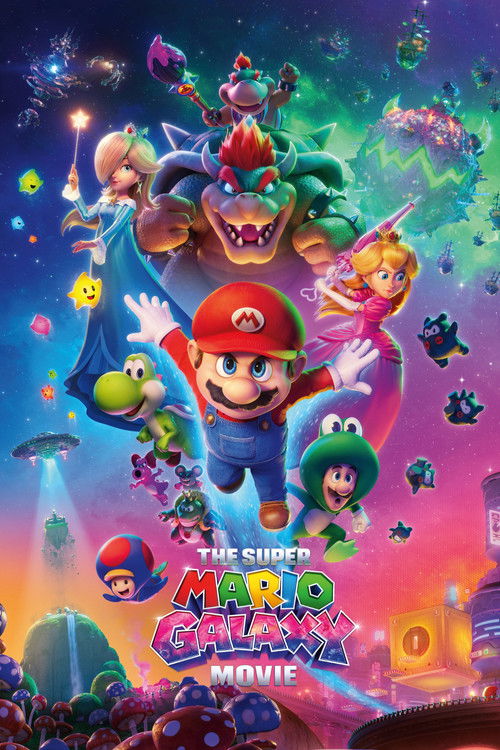
The Super Mario Galaxy Movie moves like a slideshow set to a metronome. Every few minutes it opens a new world, holds it just long enough for you to register the color and the reference, then warps to the next one. This is the governing decision of the whole film, and everything else follows from it. Aaron Horvath and Michael Jelenic, returning from the 2023 original, have built a 98-minute vehicle for momentum. Whether that momentum is exhilarating or exhausting is the question the movie keeps handing back to you.
Editorial Deep
Score breakdown, defended
Each dimension scores what it scores. The number is the claim; the prose is the defense.
Editorial Layer
Flat mean of the five dimensions below. Contributes 71% to the Skry Score.
The screenplay makes one governing choice and commits to it: motivation is optional, and the film is willing to play the gap for a laugh, as when Yoshi joins with no explanation and Toad names the absence aloud. Treated as pure avatar-adventure, that stance has a defense. But the writing doesn't hold the line cleanly. It introduces a new Peach origin, sets up a Bowser Jr. daddy-issues arc, and then resolves both perfunctorily while sidelining the Mario-Peach thread by keeping the pair apart. The result is a script that clears space for character and fills none of it, and stacks two Bowsers into a climax where one would have landed harder. The dialogue and comic timing function; the structural and thematic clarity do not cohere. That is a genuine shortfall at the writing's own aims, not a matter of scope.
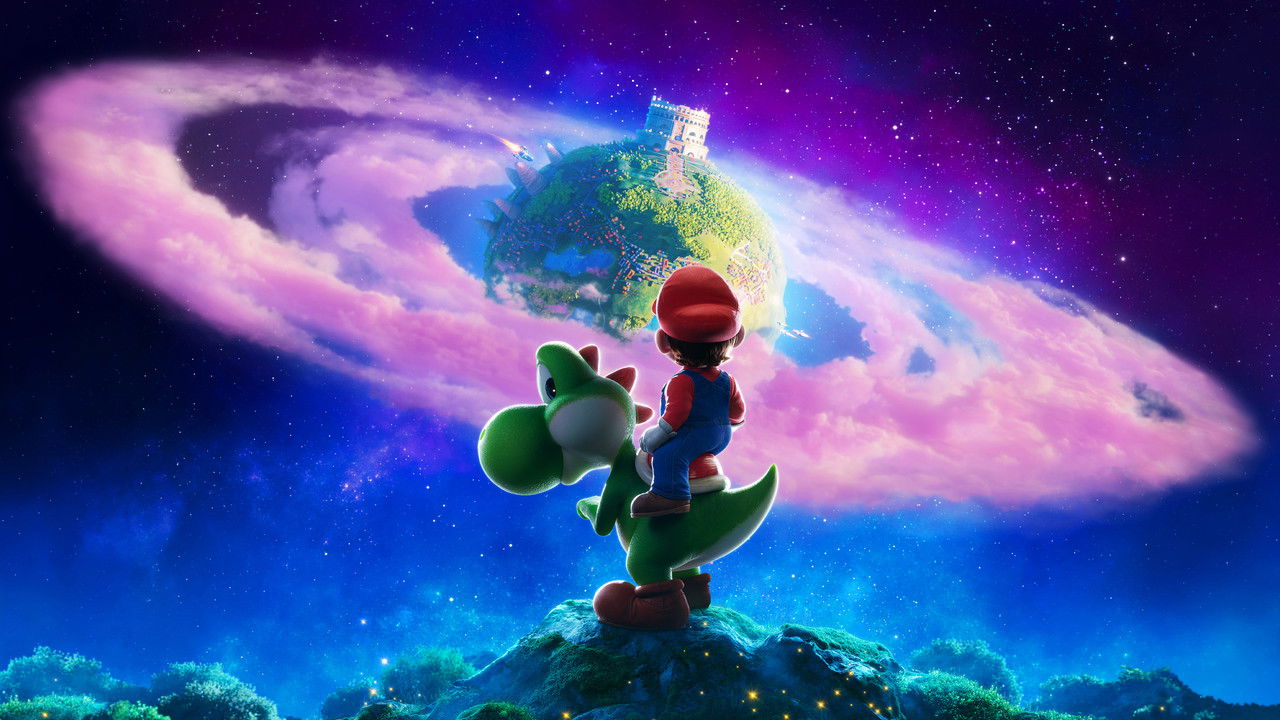
This is the film's real command. The animation team stages a castle invasion that alternates a CG 3D world with a flat 2D side-scrolling register in sustained back-and-forth, shifts into full 2D anime for the Star Fox sequence, and executes a long continuous shot of characters fleeing a collapsing structure with evident control. The imagery is screen-filling and built for a theatrical scale, capturing intensity at every register from intimate brawl to galactic chase. Multiple set pieces per act make the color pop and give blows real weight. The visual invention is the clearest thing the film does well and it does it with confidence.
The ensemble is deep and mostly delivers on what the roles ask. Glover's Yoshi is the standout, a babyish coo that echoes the in-game sound and integrates into the group's comedy instantly, one of the film's most effective beats. Safdie gives Bowser Jr. a specific pipsqueak-tyrant energy even where the writing strands him. The relay-fight staging lets the principals play off each other with real snap. The limitation is the material more than the performers: Peach is given less to do than before, and several voices are asked to animate characters the script declines to deepen. Within that constraint the cast lands its comedy and its intensity.
Momentum is the film's whole proposition and it delivers relentless forward drive. The rhythm of world-gag-spectacle-next never flags, and Tyler's orchestral score gives each locale a distinct pulse the cutting would otherwise blur past. The set pieces have genuine kinetic charge. The cost of that velocity is the flip side of the same coin: nothing is allowed to settle, no emotional beat gets room to accumulate, and the two-Bowser climax diffuses rather than peaks. It moves beautifully and feels thin between the movements. Strong drive, weak swell.
There are concrete reasons to return, and they are visual: the 2D-to-3D castle sequence, the anime Star Fox detour, the collapsing-building shot reward a second look for their craft, and the density of references invites the completist. But the film is engineered against retention, structured to prevent attention from settling, and the characters stagnate into affability that offers little new on a second pass. What rewards rewatching is the animation, not the architecture; the set pieces hold up while the connective story evaporates.
The best three minutes of a Mario movie are the ones where it stops being a Mario movie.
What the animation team can do is not in dispute. There is a castle-invasion sequence that toggles between the film's CG world and a flat, side-scrolling register borrowed from the 2D games, and the back-and-forth is genuinely inventive, the kind of formal play the rest of the film mostly declines to attempt. A galactic space chase and a long continuous shot of characters fleeing a collapsing structure show off scale and control. The fight choreography has a relay logic to it, with Mario, Luigi, and the newly introduced Yoshi tagging in and out of brawls in a rhythm closer to kung-fu staging than anything you expect from a family cartoon. When the picture leans fully into a set piece, it pops.
Brian Tyler's fully orchestral score does more quiet work than the visuals get credit for. Reworking the original game themes and dropping the licensed pop songs that cluttered the first film, it gives each locale a distinct sonic identity the editing rarely sits still long enough to earn on its own. It is the connective tissue the screenplay leaves out.
Because the screenplay does leave it out. Matthew Fogel's script treats character motivation as optional and sometimes as a punchline; Yoshi joins the team for no stated reason, and the film knows it, letting Toad ask the question aloud. Some viewers will read this as honesty about what these characters are, which is to say bright avatars for adventure rather than people with interiors. Others will feel the hollow where an arc should be. Both readings are available, and the movie does little to tip the scale.
The voice cast is stacked and mostly does what the material asks. Donald Glover's Yoshi is the standout, a babyish coo that mimics the in-game sound and slots into the group's comedy with immediate ease. The Star Fox detour, which shifts into a 2D anime register, is the single most alive stretch in the film, and it is also the sequence that has the least to do with Mario at all. That is worth sitting with.
So here is the honest verdict. If you want to be dropped inside a Nintendo game for an hour and a half, handed one gorgeous vista after another and asked to feel very little between them, this delivers exactly that and does it with real craft. If you want a story that accumulates, that builds a place you can stand in and characters who change while standing there, the film keeps moving before any of that can form. It is beautiful on the surface and thin underneath, and it is largely at peace with the trade. Your mileage depends entirely on whether you consider that a bug or the whole point.
Beyond this line, spoilers
The Conversation
First-person welcome. Pushing back on consensus is a tool, not a formula.
I keep landing on the Star Fox sequence, and I think it tells you everything. The best three minutes of a Mario movie are the three minutes where the film stops being a Mario movie, switches to 2D anime, and lets Peach and Toad meet Fox McCloud. That is not a small observation. It is the movie quietly confessing that its most inventive instinct is to escape its own premise. And of course Fox is being teased for his own picture; nearly every scene here is a foyer for some future installment. You can feel the cinematic universe being assembled in real time, one cameo at a time.
Owen Gleiberman called it frenetic and disappointing, a threadbare adventure that never settles on a locale long enough to give you a sense of place, and I think he is right about the mechanism even if I am softer on the result. Two Bowsers in the climax really do add up to less than one. Benny Safdie's Bowser Jr. is a fun little pipsqueak tyrant, but his daddy-issues arc resolves so perfunctorily that the second Bowser mostly dilutes Jack Black, who, yes, never gets a song this time. That is a strange thing to withhold from your best asset from the first film.
Bianca Farmakis, scoring it low, argued it is designed to be forgotten the instant each scene ends, engineered for an attention-deficit economy, and that you'll retain maybe a single-digit number of sequences. I don't fully buy the cynicism, but I can't fully wave it off either, because the film's structure genuinely does mimic a scroll feed. World, gag, spectacle, next. It is built to prevent your attention from settling.
And yet. Soren Andersen scored it 75 and made the case I find hardest to dismiss: the screen-filling imagery, the wall-to-wall Easter eggs, are best experienced theatrically, and there is a real pleasure in feeling like you are inside the 2007 game. That is a legitimate thing for a film to offer. Jesse Hassenger graded it a C and put his finger on the exact fault line, praising the little rushes of opening new worlds while every character stagnates into bland affability. Both critics are describing the same movie. One is charmed by the rush and forgiving of the stagnation, the other is not. The film cannot be defended or convicted without conceding the other side's evidence, and that is unusually true here.
What would I cut? Not the set pieces, which are the reason to show up. I'd cut a Bowser. Consolidate the villains, give Jack Black the song and the room, and let one antagonist carry actual weight. The two-Bowser climax is the clearest case of the film's more-is-less arithmetic, where doubling a thing halves its impact.
The minimalism debate is the one I keep turning over. There's a genuinely defensible reading that treating Mario and Luigi as candy-colored avatars rather than psychological subjects is the correct and even relieving choice for this IP. I'm sympathetic. The problem is not that the characters lack interiors. It's that the film gestures at arcs anyway, gives Peach a new origin Miyamoto is now canonizing, sidelines her romance by keeping her and Mario apart for most of the runtime, then does nothing with the space it cleared. If you're going to abandon character, abandon it cleanly. Half-abandoning it is the worst of both.
The money makes all of this academic in one sense. Biggest debut of 2026 at $130.9 million, past a billion worldwide, the predecessor still the highest-grossing game adaptation ever. Miyamoto is baffled by the hostility and doubling down. None of that is a craft argument, but it is the context in which every craft argument now happens. The audience has already voted, warmly, and the split with critics is the same one that defined the first film. I don't think either side is lying. I think they want different things from ninety-eight minutes, and this movie made a clean choice about which of them to serve.
Cast & Crew
Who made it, and who’s in it.
Cast

Chris Pratt
Mario (voice)

Anya Taylor-Joy
Princess Peach (voice)
Charlie Day
Luigi (voice)

Jack Black
Bowser (voice)
Donald Glover
Yoshi (voice)
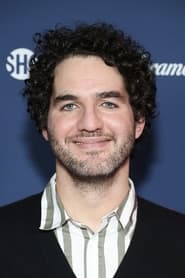
Benny Safdie
Bowser Jr. (voice)

Brie Larson
Rosalina (voice)
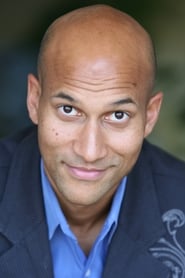
Keegan-Michael Key
Toad (voice)

Glen Powell
Fox McCloud (voice)

Luis Guzmán
Wart (voice)

Issa Rae
Honey Queen (voice)
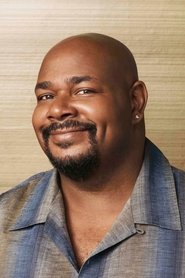
Kevin Michael Richardson
Kamek (voice)
Crew
- DirectorAaron Horvath
- DirectorMichael Jelenic
- ScreenplayMatthew Fogel
- EditorEric E. Osmond
- Original Music ComposerBrian Tyler
Trailer
Plays on YouTube, in a new tab.
 Final Trailer · 2026Watch on YouTube
Reader response
About the Editor
Derik Silva
Editor-in-Chief
Derik founded The Skry to do for film and television what aggregator culture stopped doing — read closely, score honestly, and defend the score in writing. He believes the long arc is the only arc that matters: the films that earn their reputation by holding up over years, and the ones whose reputations have grown larger than the films can carry. Previously, he founded Travault.
The Skry Dispatch
Read closely, weekly. Reviews and dispatches from The Skry.