
Film Review
Parasite
Song Kang-ho · Lee Sun-kyun · Cho Yeo-jeong
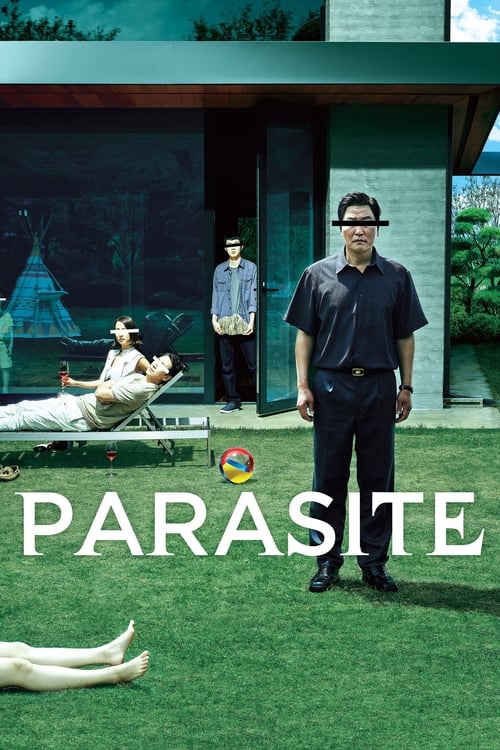
Bong Joon Ho's Parasite runs 133 minutes and spends every one of them building something it can knock down. The premise is a con: the Kim family, packed into a semi-basement where they thumb wifi off a neighbor's signal, works its way one member at a time into the household of the wealthy Parks. Watch how the scheme is executed. The film's most exhilarating stretch is a five-minute montage assembled from dozens of shots, a coordinated deception carried out with the precision of a heist and the rhythm of farce. It is the most satisfying kind of screen mechanism: you understand exactly how each piece locks into the next, and you delight in watching it click.
Editorial Deep
Score breakdown, defended
Each dimension scores what it scores. The number is the claim; the prose is the defense.
Editorial Layer
Flat mean of the five dimensions below. Contributes 71% to the Skry Score.
The screenplay's genius is architectural: it builds a heist-comedy premise with clean, satisfying mechanics, then reveals a lower floor that reframes everything the setup taught you. The two-tier class diagram becomes three at the bunker, and the structure enacts the theme rather than stating it. Ki-woo's closing fantasy converts the softest image in the film into its cruelest, honoring Bong's refusal of false consolation. The theatrical, chamber-piece construction is a deliberate frame, not a flaw; the writing knows exactly which room it needs us in at every turn.
Two houses carry the argument before dialogue does. The semi-basement is shot in muted earth tones with hard chiaroscuro side-lighting and tight framings that pin bodies against toilet and wall; the Park house opens into clean planes and wide compositions. The flood sequence stages class as literal descent, cutting drowning stairwells against clean rain on a manicured lawn. The garden-party crane move slides from one plane of reality to another with total control. Hundreds of storyboards produced a film where every threshold and staircase is load-bearing.
Song Kang-ho makes the tonal pivot survivable, playing a defeated, adaptable patriarch whose comic register drains into something colder without a visible seam; his physical comedy and his quiet speeches to his children come from the same performance. The ensemble plays across comic and dramatic modes without a stitch showing, holding the film's whip-fast shifts together. This is collective performance calibrated to a machine that changes gears mid-scene, and no one loses the beat.
The film moves with heist momentum in its first half, the peach-allergy montage compressing an elaborate scheme into a five-minute engine of comic tension. The bunker revelation converts that momentum into dread, and the flood and garden-party sequences accelerate toward a climax that feels earned rather than sprung. The one soft spot is a mid-section stretch that admires its own cleverness a beat too long before the pivot arrives, a minor hum in an otherwise relentless build.
The construction rewards a second pass more than almost any comparable film. The Bates-house spatial logic plants clues that only read once you know the basement exists; the class geometry, the staircases, the local satirical references reward rewatching with the ending in mind. The tonal architecture, invisible on a first viewing when it feels like surprise, resolves into deliberate design on return. Density is the whole point: the bricks build, then topple, and knowing where they fall changes how you watch them rise.
Bong builds a doll's house so he can burn it, and the two films this turns out to be are just one house seen from two floors.
Then the film changes. Bong's defining move is the sudden tonal pivot, sometimes inside a single scene, and here it is the load-bearing structure of the whole. The comedy is real and it is generous, warm toward the very people it lets us laugh at. When the register shifts, it does not feel like a betrayal of the comedy but its natural consequence. The bricks build, and then they topple.
The two houses do the film's arguing before the dialogue does. Hong Kyung-pyo shoots the Kim semi-basement in muted earth tones and hard side-lighting, tight framings that pin the family against toilet and wall. The Park house opens up: clean planes, wide compositions, a lawn as an unbroken green field. Bong drew hundreds of storyboards before shooting, and the control shows in how every stairway and threshold means something. He has cited the Bates house as a model for a space that hides and reveals, and the Park home works the same way, geography as suspense.
Song Kang-ho anchors the ensemble as the Kim patriarch, a man he has described as an invertebrate, defeated and adaptable and improvising without a plan. It is a restrained, focused performance that turns, in the back half, into something harder to name. His physical comedy registers absurdity in a raised eyebrow. His quieter speeches carry a chill the comedy never prepared you for. Around him the whole cast plays across comic and dramatic registers without visible seams, and the film never once loses track of whose face it needs.
What makes Parasite land is that it never asks you to root for a scheme so much as for the people running it. Their ingenuity is the emotional center, not their criminality, so you are on their side well before the film complicates what being on their side costs. The satire is legible on its face and sharper if you know the local particulars it is drawing on, but you lose nothing essential coming in cold.
A minority position holds that the film runs long and its class argument is blunt. The length case is worth naming and then setting down: this is a machine that needs its full running time to build the pressure it eventually releases, and the pacing earns the size. Very little here is padding. Parasite is Bong operating with near-total command, a comedy and a thriller that turn out to be the same film seen from two floors of the same house.
Beyond this line, spoilers
The Conversation
First-person welcome. Pushing back on consensus is a tool, not a formula.
Now I can talk about the floor beneath the floor.
The bunker is the hinge. When the Kims discover Geun-se, the former housekeeper's husband, living in the shelter under the Park house, the film stops being a heist comedy and becomes something with claws. What I admire is that Bong doesn't smash the two modes together; he lets the second grow out of the first. The Kims have spent the movie treating the Park house as a stage set they've learned to work. The bunker tells them the set has a basement they never cast, and that there was always someone below the people they thought were at the bottom. The class diagram the film has been drawing in two tiers suddenly has a third.
That's why the flood sequence hits as hard as it does. The Kims descend an endless run of stairs and streets back to a semi-basement drowning in sewage, and Bong cuts that against the Parks watching clean rain fall on a manicured lawn. Same storm, two weathers. It's the sharpest image in the film and it works because the descent is literal: down and down, the geography doing the thesis without a word of dialogue.
Then the garden party. The crane move over Mrs. Park's shoulder that finds Da-song's cake on the ground moves us from one plane of reality to another, and the violence that follows feels less like a twist than a debt coming due. I won't relitigate every beat, but I want to defend the ending against the charge that Bong is being reductive. His stated aim was to reflect the current moment and not hand out false hope, and the close honors that. Ki-woo's fantasy of buying the house, so the father can simply walk up the stairs, is the cruelest thing in the movie precisely because it's the softest. The film lets him dream and lets us see the dream is a wall.
The dissent deserves a fair hearing. One line of argument says Parasite is half an hour too long and its ideology is nonsense; another that the script is theatrical, with character setups full of logical holes, and no central oomph. I'd push back on the runtime charge hardest. The peach-allergy montage alone justifies the film's patience: it is a piece of construction, sixty-odd shots doing what a lesser film would summarize, and you cannot get the payoff without the setup time. The theatricality point lands more. Parasite is a play in its bones, a chamber piece about who is allowed in which room, and if you want cinema to be about landscape rather than architecture, this will read as staged. I think the staging is the point. Bong builds a doll's house so he can burn it.
What I'd actually flag for cutting: nothing structural, but the film's mid-section can feel like it's admiring its own cleverness for a beat too long before the bunker arrives. That's the one stretch where the machine hums a little in neutral. It's a small charge against a film this controlled.
Song Kang-ho is the reason the tonal pivot survives. His patriarch is an invertebrate right up until the moment he isn't, and the film's whole moral weather lives in that face. When he speaks to his children, the comic register drains out and something colder settles in, and you believe both the man who cracked jokes an hour ago and the man in front of you now. The ensemble's shared SAG is the right kind of prize for this: no one is soloing. But it's Song who has to carry the seam between the two films Parasite is, and he never lets you see the stitch. That the movie became the first non-English feature to take Best Picture feels, watching it now, less like a barrier falling than a machine finally meeting an audience wide enough to hear it click.
Cast & Crew
Who made it, and who’s in it.
Cast

Song Kang-ho
Kim Ki-taek
Lee Sun-kyun
Park Dong-ik

Cho Yeo-jeong
Yeon-kyo

Choi Woo-shik
Ki-woo

Park So-dam
Ki-jung

Lee Jung-eun
Moon-gwang

Jang Hye-jin
Chung-sook
Park Myung-hoon
Geun-se

Jung Zi-so
Da-hye

Jung Hyeon-jun
Da-song

Park Keun-rok
Driver Yoon

Jung Yi-seo
Pizza Manager
Crew
- DirectorBong Joon Ho
- Director of PhotographyHong Kyung-pyo
- EditorYang Jin-mo
- Original Music ComposerJung Jae-il
Trailer
Plays on YouTube, in a new tab.
 Official Australian Trailer [Subtitled] · 2019Watch on YouTube
Reader response
About the Editor
Derik Silva
Editor-in-Chief
Derik founded The Skry to do for film and television what aggregator culture stopped doing — read closely, score honestly, and defend the score in writing. He believes the long arc is the only arc that matters: the films that earn their reputation by holding up over years, and the ones whose reputations have grown larger than the films can carry. Previously, he founded Travault.
The Skry Dispatch
Read closely, weekly. Reviews and dispatches from The Skry.