
Film Review
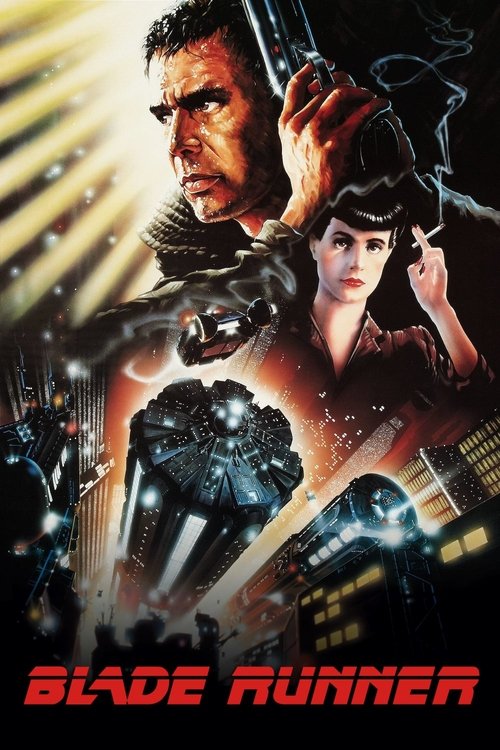
Blade Runner
Harrison Ford · Rutger Hauer · Sean Young
Blade Runner opens on an eye. An extreme close-up, the iris catching a burning skyline, and then a rise into the sprawl below: Los Angeles as permanent night, permanent rain, the horizon punctuated by industrial flares. Before a word of dialogue, Ridley Scott has told you what kind of attention the film wants. Look at everything. Look at the surfaces, the reflections, the neon cartouches advertising in languages the frame does not translate for you. The image is the argument here, and it is worth meeting on those terms.
Editorial Deep
Score breakdown, defended
Each dimension scores what it scores. The number is the claim; the prose is the defense.
Editorial Layer
Flat mean of the five dimensions below. Contributes 71% to the Skry Score.
The screenplay grafts a hard-boiled detective structure onto a science-fiction frame and lets the case keep opening onto larger moral questions, so a superficially simple hunt carries a theological and ethical charge it never announces. Batty's arc, culminating in a death scene compressed by its own logic, gives the writing a genuine spine. The honest limitation is durability of the plot mechanics: the senselessness charge has never fully died, and some connective tissue is thinner than the film's ambitions. The writing achieves its noir-as-parable aim; it does not achieve airtight narrative machinery, and does not entirely need to.
The image is the film's supreme accomplishment and the case is unhedged. Scott builds a total world, layered from aerial sweep down to the newsprint in a passing hand, lit by an enormous stock of neon and anchored in the noir tradition rather than in prediction. The design carries its own internal logic, the non-English signage supplies density without distraction, and the practical construction is the reason the picture stays visually current across generations of viewers where rendered futures curdle. Every compositional choice serves the eye-first argument the opening shot declares. This is command of the frame at a level few films reach.
Hauer's Roy Batty is the anchor: a performance built from the inside of a being with a fixed lifespan, disciplined enough to shorten its own famous scene rather than extend it, and it earns the sympathy the whole picture depends on. Ford gives Deckard a moral ambiguity that keeps the detective from flattening into a simple pursuer, and the two register against each other in productively different keys. The ensemble sustains the world convincingly. The limitation is distribution of weight: the film's power concentrates heavily in Hauer and Ford, and several strong presences serve the design more than they are given room to open up.
The film moves at the deliberate pace of noir rather than thriller propulsion, and that tempo is a choice the atmosphere justifies: the rain, the dark, the density all ask you to slow down and look. The set pieces land with real force, and the Tyrell confrontation and the rooftop finale build genuine emotional pressure. The limitation is that the same atmospheric absorption that makes the world convincing can slacken the forward drive, and the coherence debate partly grows out of stretches where mood outpaces momentum. It achieves an immersive rhythm; it trades some velocity to do so.
This is a film engineered for return. The density of the frame guarantees a viewer catches something new each pass, and the layering of a noir plot over a theological one over a slavery allegory means the picture reads differently depending on which track you follow. The opening eye seeds surveillance and mortality motifs that pay off across the runtime. Its status as a founding cyberpunk text adds a second-order reason to return, tracing how much later work descends from it. The architecture genuinely deepens on rewatch rather than merely surviving it.
A detective story dressed as the future, where the image is the argument and the frame never once betrays you by looking old.
What Scott built, at 118 minutes, is a hard-boiled detective picture wearing the future as a costume. The bones are Sam Spade and Philip Marlowe. Harrison Ford's Deckard is a man given an assignment he half wants to refuse, moving through a city whose sociology was invented after the fact to justify how it looks. That is not a knock. The design logic runs downward from the aerial sweep to the cover of a newspaper someone carries through frame, and the completeness is the point. Few films of any era feel this thoroughly inhabited. The pervasive dark and the endless rain are not mood for mood's sake; they give the light something to do, and the light does a great deal.
The reason it still reads as fresh rather than dated is material as much as conceptual. This is a practical world, layered by hand, and practical worlds age differently than rendered ones. Scott has made two films that keep their currency across generations of viewers, and this is one of them. Set it beside the clean heroic futures of its era and the difference is not merely tonal. It is a wager about what science fiction could be permitted to look like, and the wager paid.
At the center of the performances is Rutger Hauer as Roy Batty, and the film knows it. Hauer plays a being with a fixed expiration date by thinking like one, which is a stranger and more disciplined acting choice than it sounds. His most famous scene is brief because he made it brief, reasoning his way to compression rather than length. The result is a piece of screen acting people build whole careers hoping to approach once. Ford, meanwhile, gives Deckard a moral ambiguity that keeps the detective frame from settling into a simple hunt. The picture leans on both men in different registers, and both hold the weight.
The long-standing charge against the film is that the storyline is thin, occasionally senseless, plot holes papered over by gorgeous surfaces. It is an honest complaint and I won't wave it away. But the more time you spend inside the picture, the more the noir architecture reveals itself as deliberate rather than deficient: a superficially simple case that keeps opening onto harder questions about who deserves to grieve and who is permitted to. Whether you find that coherent or evasive has divided serious viewers for four decades. I land with the defenders, though I understand exactly what the dissenters are looking at.
Go in ready to watch closely. This is a film that rewards the eye first and the argument second, and it has been rewarding both for a very long time.
Beyond this line, spoilers
The Conversation
First-person welcome. Pushing back on consensus is a tool, not a formula.
Now I can talk about the thing everyone talks about.
Roy Batty's death. The rooftop, the rain, the forty-two words Hauer whittled down from a longer scripted speech because he decided a Replicant staring down his own finite clock would not waste breath on a monologue. That single reasoning move tells you why the performance works: he is not playing a monster winding down, he is playing an intelligence doing arithmetic about its own remaining seconds. Mark Rowlands has called it perhaps the most moving death soliloquy in cinema, and I'm not going to argue him down. Scott himself said Batty becomes more human than the average human, and that is the film's whole engine in one line. The sympathy the picture generates for its supposed antagonist is the reason the detective frame keeps buckling under its own moral weight.
The Tyrell sequence is the other half of that engine. Batty confronts his maker after tricking his way to the door with a chess gambit, and the scene has been read as a reworking of The Seventh Seal, the creature and the creator locked in the same losing game against death. Whether or not you buy the Bergman parallel, the film is plainly staging a meeting between a god and the thing he built to die, and it does not let the god off easy.
Then there is the scene I find genuinely hard to sit with: Deckard and Rachel. This has been fought over for forty years and it is not settled, so I'll lay out both sides honestly. Jimi Fletcher makes the case that Vangelis's Love Theme transforms a difficult encounter into something impossibly erotic and thematically complex, that the swooning score is doing deliberate work to complicate an ugly moment. The opposing reading, from a video essayist, is blunter: an explicit act of violence and abuse, Deckard extracting only the slimmest verbal permission through intimidation, a substantial blight on the legacy. I think both readings are watching the scene correctly and drawing opposite conclusions, which is uncomfortable and probably the truth of it. The score is doing exactly what Fletcher says it's doing. That is precisely the problem the dissenters name. I don't think the film resolves the tension, and I'm not sure it wants to.
The coherence debate is the one I've made peace with. Early on, the picture was hit as senseless, plot holes covered by admittedly stupendous decor. One critic went so far as to say Scott should have been a set decorator rather than a director. Pauline Kael's pan ran three pages and stung Scott so badly he stopped reading his own press in 1982 and reportedly never started again. And yet Roger Ebert, who missed the film's qualities the first time, reversed himself decades later. Consensus has moved hard toward the defenders. Scott, for his part, has called the idea that the film's appeal rests on its incompleteness absolute horseshit, and insists the thing was fully designed. Having watched how tightly the design logic holds, I believe him more than I believe the plot-hole ledger.
What keeps me returning is the thickness of it. The reading of the replicants as a slave class, the surveillance motifs seeded in that opening eye, the way the noir plot and the theological one run on the same track. This is a founding document of cyberpunk and tech noir, and you can trace its DNA forward through decades of work by filmmakers who grew up on it. Villeneuve, Nolan, del Toro, the Wachowskis, Rian Johnson. Nolan says he's seen it hundreds of times. I understand the compulsion. There is always another layer in the frame you didn't clock last time, and the frame never betrays you by looking old.
Cast & Crew
Who made it, and who’s in it.
Cast

Harrison Ford
Deckard

Rutger Hauer
Batty

Sean Young
Rachael

Edward James Olmos
Gaff

M. Emmet Walsh
Bryant

Daryl Hannah
Pris
William Sanderson
Sebastian
Brion James
Leon
Joe Turkel
Tyrell

Joanna Cassidy
Zhora

James Hong
Chew
Morgan Paull
Holden
Crew
- DirectorRidley Scott
- ScreenplayDavid Webb Peoples
- Director of PhotographyJordan Cronenweth
- EditorMarsha Nakashima
- Original Music ComposerVangelis
Trailer
Plays on YouTube, in a new tab.
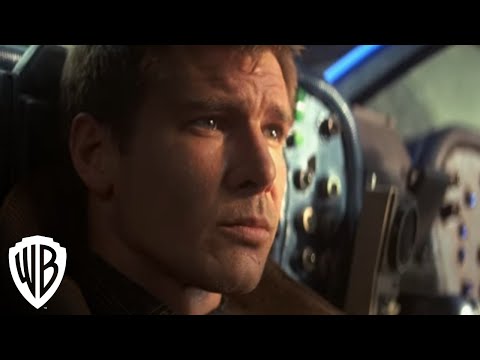 30th Anniversary Trailer · 2012Watch on YouTube
 Reader response
About the Editor
Derik Silva
Editor-in-Chief
Derik founded The Skry to do for film and television what aggregator culture stopped doing — read closely, score honestly, and defend the score in writing. He believes the long arc is the only arc that matters: the films that earn their reputation by holding up over years, and the ones whose reputations have grown larger than the films can carry. Previously, he founded Travault.
The Skry Dispatch
Read closely, weekly. Reviews and dispatches from The Skry.