Film Review
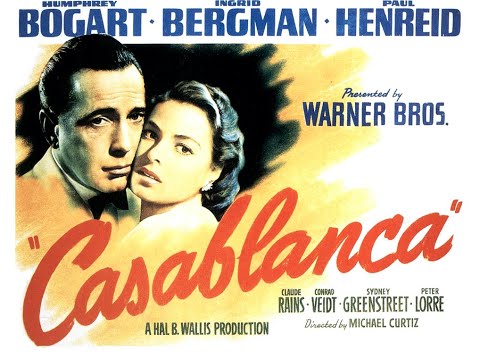
Casablanca
Humphrey Bogart · Ingrid Bergman · Paul Henreid
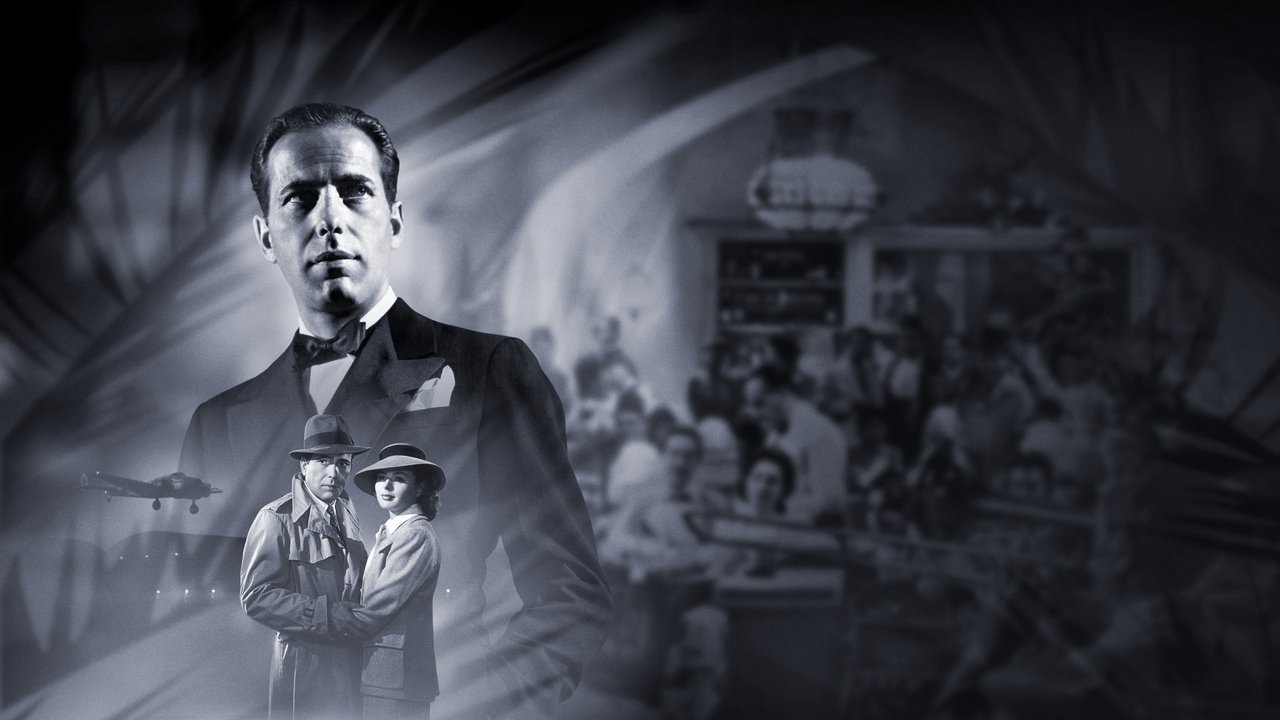
Eighty years on, Casablanca is more argued-about than most films made last year, and the strange thing about returning to it is how little the machinery creaks. The 102 minutes move with a compression that shames films twice their weight. Michael Curtiz builds the world of the café first, in shadow and severe line, before he ever asks it to carry a love story, and that sequencing matters. The moral atmosphere is established through light: low key, hard-edged, borrowing from German Expressionism and the emerging grammar of noir, so that by the time the emotional stakes arrive they land in a room we already believe is dangerous.
Editorial Deep
Score breakdown, defended
Each dimension scores what it scores. The number is the claim; the prose is the defense.
Editorial Layer
Flat mean of the five dimensions below. Contributes 71% to the Skry Score.
The screenplay's withholding architecture is its defining achievement: the Paris backstory is held back and released through flashback so that the central reunion pays off on return rather than on arrival. The dual-conflict wiring links private heartbreak to the war effort so each forces the other, letting the film work at two scales without strain. The dialogue stays economical and cynical and refuses to date. The honest limitation is that the emotional turns lean openly on sentiment; the film courts melodrama, and only its structural control keeps it upright.
The image does specific work: low-key lighting, severe lines, and shadow establish a dangerous moral world before the romance arrives, drawing on Expressionism and emerging noir grammar. Black-and-white here is a choice that has aged better than color would have, keeping the frame legible and unfussy. The composition consistently serves the drama rather than announcing itself. The limitation is that the visual language is atmospheric and functional rather than pushing beyond the studio idiom into anything formally radical.
Bogart's performance is built on the tension between a cynical surface and the feeling straining beneath it, and the film's patience lets that pressure hold until it breaks. Bergman supplies warmth shadowed by uncertainty, and she draws a sensitivity out of Bogart that stabilizes the whole triangle. Rains is present and precise in nearly every scene while ceding the frame to the leads, a real feat of ensemble discipline. The company of refugee actors gives the surrounding roles unexpected weight. The one gap is that the third point of the triangle is less individually shaded than the two leads.
The film moves. In 102 minutes it establishes a world, plants a triangle, detonates the bandstand sequence as a structural hinge, and drives toward the airport without slack. The La Marseillaise scene converts momentum into decision, forcing every character's hand at once, and the farewell braids suspense, romance, and comedy into a single sustained sequence. The rhythm is confident and unhurried at once. Its emotional beats are broad by design, which is the cost of operating this openly.
This is the dimension the film most clearly wins. Its central scenes are engineered to change meaning on a second pass: the reunion reads as puzzle first and heartbreak later, once Paris is known. The best defense of the film rests on exactly this deepening, the sense that it rewards return like a piece of music you keep coming back to. The layered performances, the density of quotable writing, and the collaborative richness beneath the surface all give a rewatcher new footholds. Few films of its era hold up to repeat viewing this completely.
The withholding is not a flaw of construction. It is the construction, and it turns a first-viewing puzzle into a second-viewing heartbreak.
The screenplay's central manoeuvre is withholding. The Paris backstory that explains the whole triangle is kept back and released in flashback, which means the film's most famous reunion plays as puzzle on a first viewing and as heartbreak on a second. This is not a flaw of construction; it is the construction. The dialogue is spare and cynical and has not curdled into camp the way lesser period writing does. It stays quotable because it stays economical.
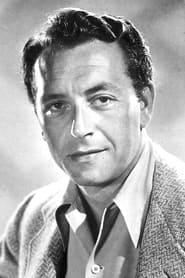
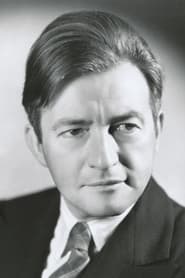
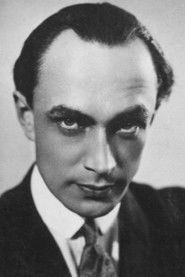
Humphrey Bogart's work here is a study in surface and pressure. The cynical exterior is the whole point of the performance, and the film is patient enough to let it hold until it cannot. In the final scenes he plays a man exploding with feeling behind a face that refuses to show it, and the restraint is the achievement. Ingrid Bergman gives the film its warmth and its unease at once, a tenderness shadowed by something unresolved, and she draws a sensitivity out of Bogart that steadies the whole triangle. Claude Rains, as the accommodating prefect, is arguably the most reliable pleasure in the cast, present and sharp in nearly every scene while professionally ceding the frame to the leads. Paul Henreid and Conrad Veidt hold the film's outer poles, resistance and menace, with a clarity that keeps the politics legible without turning didactic.
What keeps Casablanca from tipping into pure melodrama is that its two conflicts are wired together. The private heartbreak and the larger effort against the Third Reich are not parallel tracks; each forces the other's hand. The result operates on an intimate and a historical scale at the same time, and the propaganda works precisely because it arrives as a by-product of the drama rather than a lecture bolted onto it.
There is a dissenting tradition worth taking seriously. Pauline Kael found it far from great, a piece of appealingly schlocky romanticism that never demands to be taken seriously, and Manny Farber granted only that the cast made it a pleasure of sorts. The complaint is not baseless: the film courts sentiment openly and never apologises for it. But sentiment executed with this much control is not the same as sentiment indulged, and the picture keeps earning its emotion through structure rather than begging for it.
If you have somehow never seen it, the surprise is how unforced it feels. The reputation suggests something stiff and monumental. The film itself is quick, funny in places, and built to be watched more than once.
Beyond this line, spoilers
The Conversation
First-person welcome. Pushing back on consensus is a tool, not a formula.
I want to start with the thing that changed how I watch this film, which is the idea that Bergman played the whole shoot without knowing who boards the plane at the end. Whether or not that resolves cleanly as production history, it is a useful lens on what her performance actually does. She never tilts toward a known resolution, and that unresolved quality is exactly what makes her scenes convincing. Certainty would have flattened her.
Then there is the La Marseillaise sequence, which one critic has called cinema's single greatest scene. I would not go to the mat for the superlative, but I understand the argument. When Laszlo walks to the bandstand and the refugees drown out the German song, the film uses a musical set piece as a structural hinge. Every major character is forced into a decision they would rather not make, and those decisions drive the rest of the picture. It is the moment the romance and the war stop being separate problems.
The 'As Time Goes By' reunion is the case study for the withholding structure. On first viewing it is a man storming out over a song. On repeat it is devastating, because you now carry Paris with you. Roger Ebert made this the center of his defense: the film deepens on return like a favorite album, and that deepening is his evidence for greatness rather than mere craft. I find this the strongest pro-Casablanca argument going, more persuasive than the aggregate scores, which are near-perfect but tell you popularity, not why.
The airport farewell is where suspense, romance, and comedy braid together in a way that still feels rare, and it lands the film's most quoted line. It also has to survive the letters of transit, which are famously incoherent as a legal device. Signed by a Vichy general who had left, or a Free French general with no authority in Vichy territory. It has never been resolved and it does not matter, which is the whole point of a MacGuffin. The film wants the letters to be a lever, not a document.
The authorship question interests me most. Andrew Sarris called this the most decisive exception to the auteur theory, and he had a point: the greatness here is collaborative, assembled from Koch's script layers, Steiner's score, a room full of refugee actors, and a producer who wrote the last line and dragged Bogart back to record it. Against that, there is a reading of Curtiz as a genuine stylist whose von-Sternbergian expressionism marks his noir-adjacent work as his own. I lean toward the collaborative account, but the visual atmosphere is consistent enough that I would not dismiss the auteur case.
One more thing worth sitting with. Many of the actors playing Nazi officers were German Jewish refugees who had fled the actual regime. Audiences in 1943 could not see that, but it gives the ensemble a weight underneath the melodrama that no direction could manufacture. Bergman herself never rated this among her important performances, which is a wonderful irony given that it is the one everyone wants to discuss. Sometimes the film you undervalue is the one that outlives you.
Cast & Crew
Who made it, and who’s in it.
Cast
Humphrey Bogart
Rick Blaine
Ingrid Bergman
Ilsa Lund
Paul Henreid
Victor Laszlo
Claude Rains
Captain Louis Renault
Conrad Veidt
Major Heinrich Strasser

Sydney Greenstreet
Signor Ferrari
Peter Lorre
Ugarte

S.Z. Sakall
Carl

Madeleine Lebeau
Yvonne
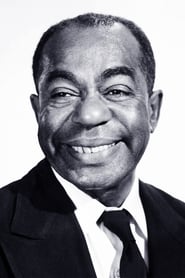
Dooley Wilson
Sam

Joy Page
Annina Brandel
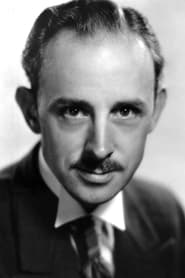
John Qualen
Berger
Crew
- DirectorMichael Curtiz
- ScreenplayPhilip G. Epstein
- Director of PhotographyArthur Edeson
- EditorOwen Marks
- Original Music ComposerMax Steiner
Trailer
Plays on YouTube, in a new tab.
 Park Circus Trailer · 2012Watch on YouTube
 Reader response
About the Editor
Derik Silva
Editor-in-Chief
Derik founded The Skry to do for film and television what aggregator culture stopped doing — read closely, score honestly, and defend the score in writing. He believes the long arc is the only arc that matters: the films that earn their reputation by holding up over years, and the ones whose reputations have grown larger than the films can carry. Previously, he founded Travault.
The Skry Dispatch
Read closely, weekly. Reviews and dispatches from The Skry.