Film Review
Moana
Catherine Lagaʻaia · Dwayne Johnson · Rena Owen
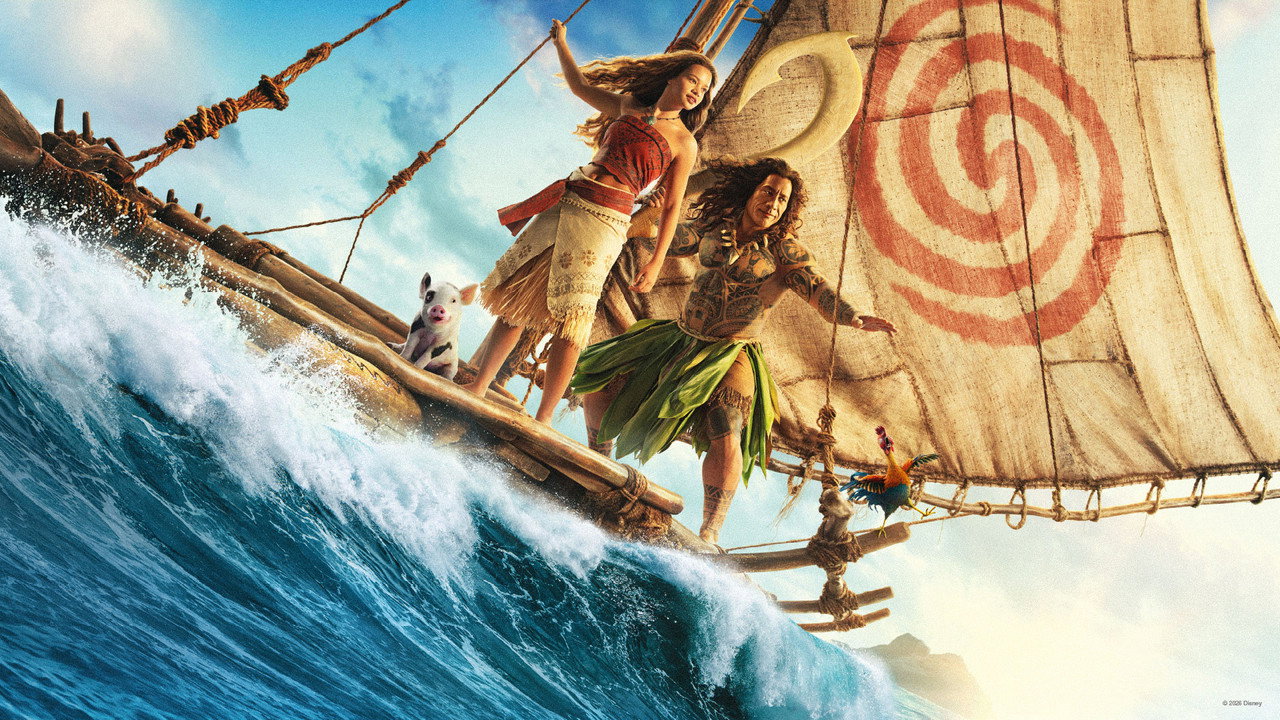
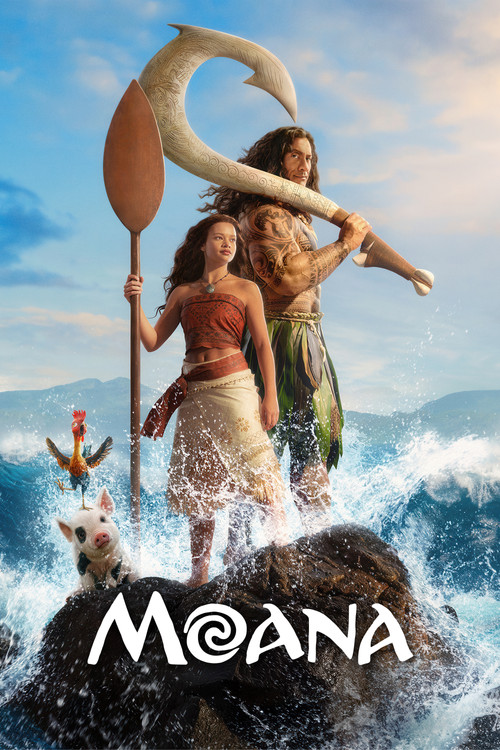
The 2026 live-action Moana arrives as a strange kind of double exposure: a film built almost entirely from the outline of the 2016 animated one, printed over with skin, water, and weather. Thomas Kail, a director whose reputation was forged on the stage and in the concert-film grammar of Hamilton, steps into a form that gives him very little room to intervene. The result is a movie that reproduces the beats of a story a great many viewers already carry in their bodies, and asks whether reproduction can carry feeling on its own.
Editorial Deep
Score breakdown, defended
Each dimension scores what it scores. The number is the claim; the prose is the defense.
Editorial Layer
Flat mean of the five dimensions below. Contributes 100% to the Skry Score.
The screenplay reproduces a structure that already works and preserves the franchise's real distinction, a female lead whose arc is never routed through romance. The single new song is its only original writing beat. But a remake this faithful abdicates the writer's central job: it adds nothing to the source and, by transposing animated beats into a literal register, drains some of their propulsion. The intent is fidelity, and it hits that; the limitation is that fidelity leaves the script with almost no independent reason to exist, which is a genuine failure of intent for a feature-length adaptation rather than a minor shortfall.
The image is the film's most confident domain. Island settings, costume, and effects are mounted with real scale, and Faura's photography gives the ocean genuine weight; 'We Know the Way' achieves actual theatrical grandeur. The considered limitation is a deliberate trade: the pursuit of photorealism sacrifices the elastic, sweeping vitality of animation, so the frame is beautiful but less alive than the thing it copies. Strong, handsome work that achieves its polished aim while accepting a real cost.
Laga'aia is the clear asset, holding a leader's wisdom and a teenager's impatience in a single grounded, warm performance that carries scenes built to be carried by animation. That is accomplished lead work in a debut. The limitation is opposite her: Johnson, embodying a role he once voiced, reads restrained and cooler than the material needs, and the central pairing never fully warms. One excellent performance and one that undercuts the film's core relationship average out to solid rather than distinctive.
The songs still deliver their peaks, and Laga'aia's numbers generate real momentum in isolation. But the film's rhythm is inherited rather than freshly built, and faithful reproduction of a leaner story stretched into live-action photography produces slack; the movement sags where the original snapped. It achieves its emotional beats mainly by borrowing them, which leaves the felt experience uneven and, in stretches, heavier than its runtime.
A second pass has a hard time finding new architecture, because the film is by design a copy with little subtext or density beneath its surface. The reason to return is Laga'aia's performance and the production's craft, not layered construction or fresh discovery. Judged against its own modest aim of re-presentation, it offers little that rewards revisiting beyond what the original already provides more vividly.
A movie made from the outline of a beloved film, printed over with skin, water, and weather; it moves you only in the places the original already did.
The honest answer is uneven, and the fault line runs through the casting. Catherine Laga'aia, making her screen debut, is the reason to see this. She plays Moana with a grounded, feisty warmth, holding the wisdom of an emerging leader and the impatience of a teenager in the same gesture. When she sings 'How Far I'll Go,' the moment lands with a directness that the surrounding film rarely matches. She is a genuine discovery, and she carries scenes that were designed to be carried by animation.
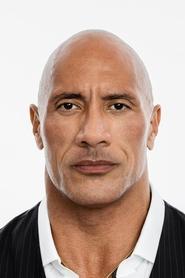
Opposite her, Dwayne Johnson returns to a role he first gave his voice to, and the transfer into flesh costs something. The larger-than-life bravado that read so cleanly in animated form comes across here as restrained, even muted, and the chemistry between the two leads stays cooler than the material wants. It is a curious problem: an actor made smaller by embodiment.
The production values are not in question. The island settings, the costume work, and the visual effects are handsomely mounted, and Óscar Faura's photography gives the ocean genuine scale. 'We Know the Way' still gathers real theatrical grandeur, drums and all. Yet the film's central craft bet is where opinion divides most sharply: in chasing photorealism, it trades away the sweeping, elastic vitality that made the animated version move. Realism is achieved. Vitality is the price.
The one wholly new element is 'Along the Way,' a Lin-Manuel Miranda duet for Laga'aia, Johnson, and Auliʻi Cravalho, and it is the piece of fresh material most likely to travel beyond the theater. It is also, tellingly, the thing the film can most clearly call its own.
At 115 minutes, faithfulness is both the design and the ceiling. If you are bringing a child to a beloved story on a big screen for the first time, the sincerity and the songs will do their work. If you are measuring this against the film it copies, you will feel the distance. I found myself moved in the exact places the original moved me, and unmoved almost everywhere else. That is either the point or the problem, depending on where you sit.
Beyond this line, spoilers
The Conversation
First-person welcome. Pushing back on consensus is a tool, not a formula.
I want to take the disagreement about this film seriously, because it is the most interesting thing about it. The critical split here isn't noise. It maps, almost cleanly, onto a single question: who is this for?
Owen Gleiberman makes the strongest case for the defense, and it is not a lazy one. He argues this is the first Disney live-action remake that truly works, that Laga'aia plays Moana with beaming rapture, and that a child who has never seen the 2016 film will receive this one fully and authentically. That last clause is the crux. If you accept that the target viewer is a kid encountering the story fresh, faithfulness stops being a vice and becomes the delivery mechanism. Nell Minow lands in a measured middle: sincerity, humor, songs that remain among the all-time bangers, and a female lead whose arc is never resolved by romance. Both of them are describing a real film that real audiences will love.
Then there is the other pole, and it is fierce. Maxance Vincent argues the remake follows the original shot-for-shot and line-by-line, that there isn't a single image justifying its existence, and that whatever emotion it generates is borrowed. He is sharp on this: he admits feeling something during 'How Far I'll Go,' then names the feeling as a memory of Miranda's composition rather than anything the remake earned. Kevin Maher goes to one star, calls it a lazy cash grab, and says Johnson is three decades too old to play Maui. Alissa Wilkinson's formulation is the one that stuck with me: the film has nothing to add and winds up subtracting instead. Jeremy Jahns says it feels thirty minutes longer than it is.
Here is where I come down. I think both sides are correct about different objects, and I think the movie's own numbers tell the story of the mismatch. A $43M domestic opening, landing three weeks after Toy Story 5 and a week after Universal's Minions & Monsters, is not just marketplace noise. The animated Moana has logged more than 1.5 billion streaming hours; its audience has near-total familiarity with the source. The nostalgia machine only pays out when the original's viewers have kids of the right age, and ten years and a Moana 2 in, that conversion hasn't happened yet. The film may have arrived half a decade early for its own business model.
The Kail question is the one I keep turning over. Vincent's frustration is well-aimed: Hamilton proved this director understands the visual language of cinema and can build grandeur out of staging. So the comparative flatness here reads less like incompetence than like a form that gave him nothing to direct. His stated approach is to make uplifting work without leaving fingerprints on it. That serves a Broadway transfer beautifully. In a remake whose only justification would be an authorial reason to exist, invisibility becomes the problem. Several critics reached for Dean DeBlois's live-action How to Train Your Dragon as the counterexample, a technically ambitious remake that argued for itself. Moana doesn't make that argument.
On Johnson, I'll note the split rather than pretend it's resolved. Family reviewers found his physical presence authentic and fun, a thrill to see the voice made solid. Critics measuring him against his own animated performance found him wooden and lacklustre. I lean toward the latter read, but I recognize it's a read from a particular seat.
And I want to flag the thing the movie mostly leaves untouched: the Pacific Islander response to this franchise has been divided since 2016, some celebrating a Pasifika showcase on a global stage, others objecting to distinct island cultures blended into one composite setting and to characterizations like Gramma Tala. A remake was an opportunity to engage that conversation with a decade of hindsight. This film had other priorities.
What I'm left with is Laga'aia. Dan Murrell called her a great discovery who deserves better than a remake, and that's exactly it. The best thing this movie does is announce a performer I now want to watch in something that belongs to her.
Cast & Crew
Who made it, and who’s in it.
Cast

Catherine Lagaʻaia
Moana
Dwayne Johnson
Maui
Rena Owen
Gramma Tala

John Tui
Chief Tui

Frankie Adams
Sina

Jemaine Clement
Tamatoa (voice)
Emma Puahi-Shapazian
Moana (4 years old)
Amaya Masoli
Moana (8 years old)

Sam Puefua
Village Fisherman
Sione Milford
Coconut Farmer

Kapeneta Te'o-Tafiti
Coconut Farmer

Eric Scanlan
Tulafale
Crew
- DirectorThomas Kail
- ScreenplayJared Bush
- Director of PhotographyÓscar Faura
- EditorMelanie Oliver
- Original Music ComposerMark Mancina
Trailer
Plays on YouTube, in a new tab.
 Final Trailer · 2026Watch on YouTube
 Reader response
About the Editor
Derik Silva
Editor-in-Chief
Derik founded The Skry to do for film and television what aggregator culture stopped doing — read closely, score honestly, and defend the score in writing. He believes the long arc is the only arc that matters: the films that earn their reputation by holding up over years, and the ones whose reputations have grown larger than the films can carry. Previously, he founded Travault.
The Skry Dispatch
Read closely, weekly. Reviews and dispatches from The Skry.