Film Review
Spirited Away
Rumi Hiiragi · Miyu Irino · Mari Natsuki
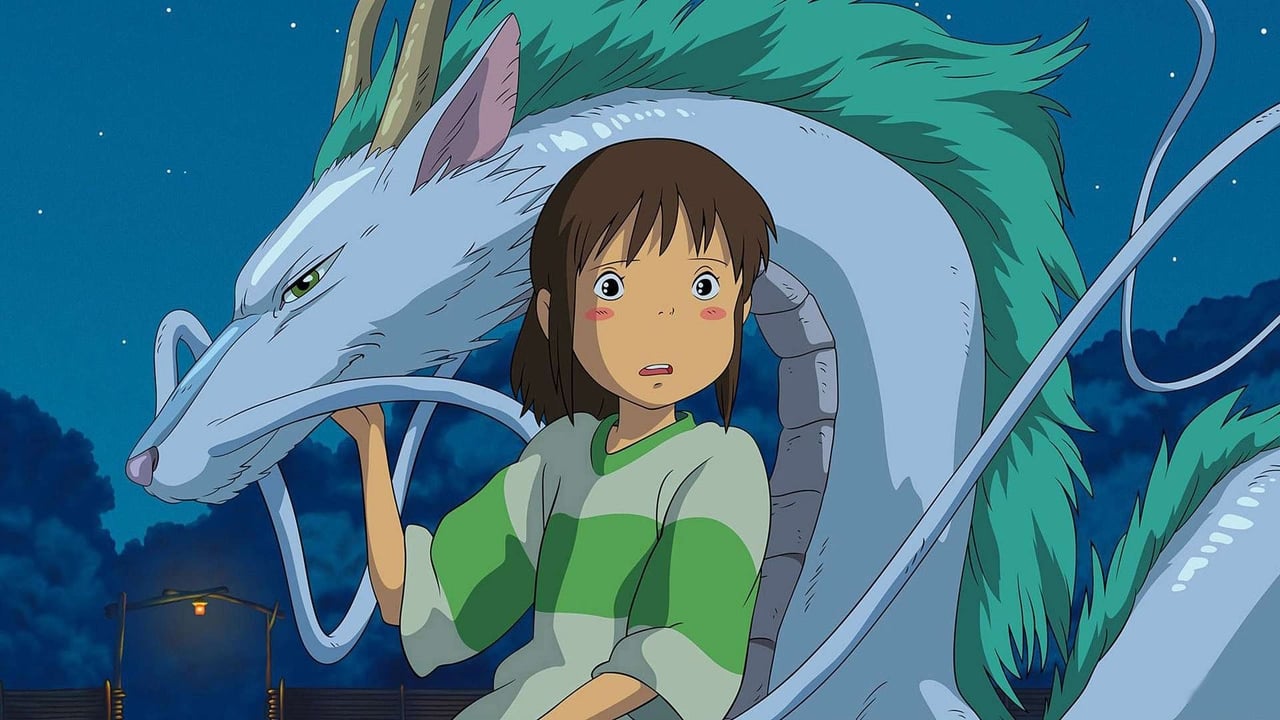
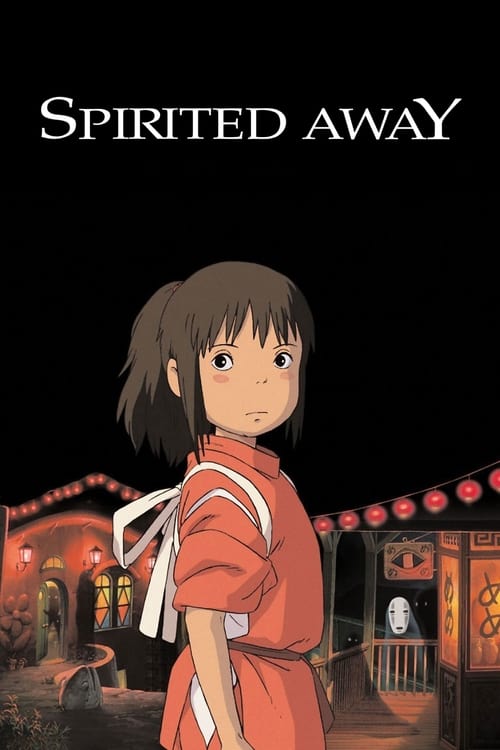
Spirited Away opens on a car ride, which is to say it opens on the ordinary. Chihiro sulks in the back seat while her parents take a wrong turn down a shrine-lined backroad, pass through a long dark tunnel, and emerge into what looks at first like an abandoned theme park. Then dusk falls, the spirit city ignites, and her parents lower their heads over food that was not offered to them. What Miyazaki builds in these first minutes is not a fantasy overture but a slow ratchet of dread: the environment turns hostile one legible cue at a time, so that by the time the horror arrives the film has already taught you how to be afraid in this place. It is one of the most controlled openings in the animated cinema, and it sets the terms for everything after.
Editorial Deep
Score breakdown, defended
Each dimension scores what it scores. The number is the claim; the prose is the defense.
Editorial Layer
Flat mean of the five dimensions below. Contributes 71% to the Skry Score.
The screenplay commits to dream-logic over dramatic mechanics, and it succeeds at that on its own terms: the withheld world-building places the viewer in Chihiro's bewilderment, and the refusal of a romantic template gives her an unusually self-authored arc. The honest limitation is structural reach. Built from storyboards rather than a locked script, the narrative drifts and never gathers into a single crisis, and the deliberately subdued ending will read to some as an unfinished transformation. This is a considered choice rather than a failure of craft, but the seams are real and the writing is the domain where they show.
The image is where this film's command is not merely achieved but distinctive. The muted blue-green palette draws its force from restraint. The bathhouse and the train are constructed as opposed visual grammars, dense clutter and constant prop motion set against silence and drift, and the contrast alone carries the emotional architecture. Shifting lighting modes track a child's psychology without a word. This is hand-drawn animation authored frame by frame, with computer work kept invisible, and it stood apart from everything else being made at the time.
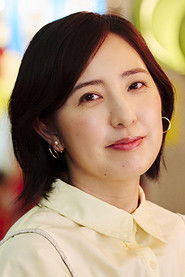
The voice performances do genuine and specific work. Rumi Hiiragi moves Chihiro from fear to resilience by degrees rather than declaration, and the twenty-second collapse into tears is a performance beat as much as an animation one. Mari Natsuki builds two distinct personalities inside a single voice, differentiating the witch from her gentler twin with real command. The limitation is scope of assessable range; the ensemble serves the images rather than dominating, which is the correct hierarchy for this film.
The film moves by accumulation rather than acceleration, and its best sequences generate feeling through pure image and motion. The opening ratchets dread with precision; the train sequence conveys loneliness before dialogue. The honest limitation is momentum: the episodic drift that suits the dream-logic also produces visibly uneven pacing, and the absence of a conventional climax means the back half releases tension it never fully rebuilds. For viewers on the film's wavelength this reads as breathing room; for others it will read as slack.
This is built to reward return. The film's durability rests on deliberate ambiguity: the spirit world is never explained, the themes never resolved into a single reading, and the structure is elastic enough to sustain new interpretations across viewings. Details reward re-watching, from the Western tableware in the witches' residences to the way lighting and prop motion chart Chihiro's mind. A film that withholds this much on first pass has something left on the second and the fifth.
Chihiro leaves the way she came in because that's what leaving feels like from the inside; the film isn't building to a climax, it's following a child through a place.
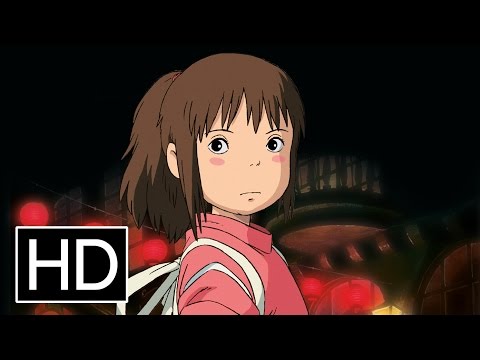
What follows is a movie that trusts image over explanation. The spirit world's bathhouse, its hierarchy, its rituals and etiquette are never fully spelled out, and that withholding is the point. You are dropped into a working economy you don't understand alongside a child who understands it even less, and the film lets you both stay bewildered. Miyazaki charts Chihiro's interior state through the surface of the picture rather than through dialogue. The bathhouse scenes press in with dense color and clutter and props in constant motion; a later train sequence, gliding across a flooded plain past translucent passengers, drains all of that away into near-silence and drift. Set those two registers side by side and you have the whole emotional architecture of the film without a line spoken.
The color palette leans blue and green, muted and washed, and its power is a matter of restraint rather than spectacle. This is hand-drawn animation with computer work used sparingly and invisibly, and the craft is not merely proficient; it is authored, every frame the product of a decision. A twenty-second beat in which Chihiro simply breaks down and sobs after seeing her transformed parents does more character work than most films manage in an act, and it is precisely that admission of fear that makes her later steadiness legible as courage rather than plot convenience.
The voice work carries real weight. Rumi Hiiragi moves Chihiro from frightened child to something sturdier without ever announcing the shift, and Mari Natsuki performs two roles, the witch Yubaba and her gentler twin, as genuinely separate people inside one voice. Joe Hisaishi's score is the one element I'd flag as contested; at its best it is among his finest for Miyazaki, though it doesn't sustain that level throughout.
A word on how you watch it. This is a film assembled from storyboards rather than a locked screenplay, and that method leaves its fingerprints. The narrative drifts; episodes accumulate rather than tighten toward a single crisis. Whether you read that as a flaw or as the film breathing according to its own dream-logic will shape your whole experience of it. I read it as the latter, but the seams are visible, and an honest recommendation names them. Come for the images, stay for a child's fear rendered with more precision than most live-action can reach.
Beyond this line, spoilers
The Conversation
First-person welcome. Pushing back on consensus is a tool, not a formula.
I want to take the dissent seriously, because the loudest objection to this film is also the most interesting one. The charge is that the story has no real climax, that Chihiro's problems resolve themselves without sufficient dramatic build, and that she re-enters the human world holding her mother's leg in the exact posture she arrived in. If you're grading on coming-of-age structure, that ending reads as a failure to deliver the transformation the genre promises.
I think the objection is right about the facts and wrong about the verdict. The unchanged posture is not an oversight; it's a claim. One reading of the film treats the coming-of-age arc as its spine, and by that measure the muted return is a letdown. Another reading treats the transformation as one thread among several, the film being elastic enough to hold consumerism, environmental anxiety, and something like xenophobia inside the same frame without resolving any of them into a lesson. I lean toward the second, and the storyboard method is why. Miyazaki isn't building toward a single dramatic payoff because he isn't writing toward one. He's following a child through a place, and children don't experience their own growth as a climax. Chihiro leaves the way she came in because that's what leaving feels like from the inside.
That said, I won't pretend the method comes free. The critic who calls this among the weaker structural entries in the Ghibli line has a case; the pacing here is more visibly uneven than in the tighter films, and if the dream-logic doesn't land for you, the drift will feel like slack rather than atmosphere. This is the film's genuine fault line, and where you fall on it is not a matter of taste alone but of what you think animation is for.
On the dub question: there's a pointed argument that the English localization sands off the film's difficulty into something generic and safe. I can't adjudicate a specific dub for you, but the underlying worry is sound. This is an emotionally ambitious film, and anything that softens Chihiro's fear into reassurance is working against its grain. See it in Japanese if you can.
The legacy is not in dispute, whatever one thinks of the structure. It stood as Japan's highest-grossing film for nearly two decades. It remains the only hand-drawn feature and the only non-English-language film to win the Best Animated Feature Oscar. Its fingerprints are on Coco and Inside Out, and Spielberg reckoned it might be better than any Disney film he'd seen. There's a nice irony there, because one thoughtful critic warns against using this movie as a stick to beat Disney with, given how honourably indebted Miyazaki is to that tradition. I'd hold both things: the film outstrips its influences without disowning them.
What keeps me returning is the train. Chihiro rides in silence past passengers who are barely there, and the film says everything about loneliness before anyone speaks. Set that against No-Face gorging and swelling in the bathhouse chaos, and you can watch a girl's mind rendered in two opposite visual grammars. That's the level this film operates on, and it's why the structural complaints, valid as they are, don't move me much.
Cast & Crew
Who made it, and who’s in it.
Cast
Rumi Hiiragi
Chihiro (voice)

Miyu Irino
Haku (voice)

Mari Natsuki
Yubaba / Zeniba (voice)
Takashi Naito
Father (voice)

Yasuko Sawaguchi
Mother (voice)
Tatsuya Gashuin
Aogaeru (voice)
Ryunosuke Kamiki
Boh (voice)

Yumi Tamai
Rin (voice)
Yo Oizumi
Bandai Frog (voice)

Koba Hayashi
River Spirit (voice)
Tsunehiko Kamijô
Chichiyaku (voice)
Takehiko Ono
Aniyaku (voice)
Crew
- DirectorHayao Miyazaki
- Director of PhotographyAtsushi Okui
- EditorTakeshi Seyama
- Original Music ComposerJoe Hisaishi
Trailer
Plays on YouTube, in a new tab.
 Official Trailer · 2014Watch on YouTube
 Reader response
About the Editor
Derik Silva
Editor-in-Chief
Derik founded The Skry to do for film and television what aggregator culture stopped doing — read closely, score honestly, and defend the score in writing. He believes the long arc is the only arc that matters: the films that earn their reputation by holding up over years, and the ones whose reputations have grown larger than the films can carry. Previously, he founded Travault.
The Skry Dispatch
Read closely, weekly. Reviews and dispatches from The Skry.