
Film Review
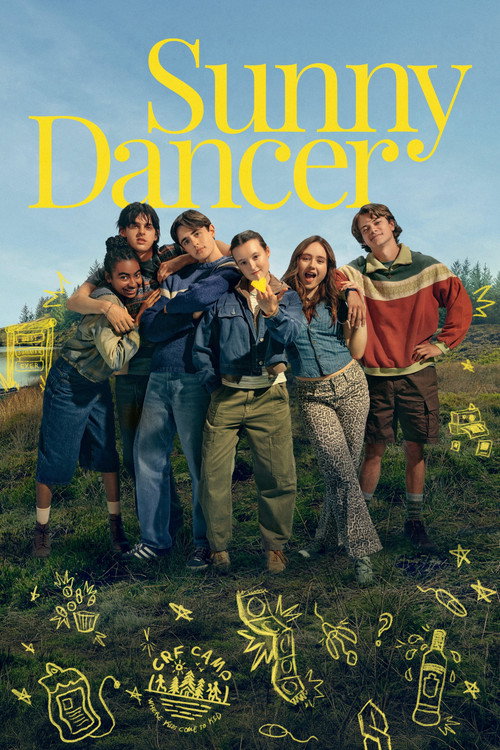
Sunny Dancer
Bella Ramsey · Daniel Quinn-Toye · Ruby Stokes
Sunny Dancer opens on a provocation. Ivy, arms crossed and unimpressed, accuses a motivational guest speaker of profiting off the grief of the campers around her. The moment nearly gets her thrown out. It also tells you exactly what George Jaques wants his sophomore feature to be: a teen cancer picture that refuses the posture of uplift even as it chases joy with both hands. That tension runs through all 106 minutes, and whether you find it electric or exhausting will decide your feelings about the whole.
Editorial Deep
Score breakdown, defended
Each dimension scores what it scores. The number is the claim; the prose is the defense.
Editorial Layer
Flat mean of the five dimensions below. Contributes 71% to the Skry Score.
The screenplay attempts something genuinely difficult: a cancer picture that foregrounds joy, keeps illness offscreen entirely, and hangs its structure on a late reveal that reframes a whole romance as imagined grief. When it commits to bluntness about death and bodies, treating its teenagers as people rather than pity objects, it earns its place. The limitation is that the tonal control isn't consistent. The comedy is broad by design but occasionally strains for a youthful register it misses, Ivy's turn from loner to ensemble member arrives faster than it should feel, and the third-act bet depends on performance to close a gap the writing leaves open. That unresolved dependence, not the ambition, is what holds this below the competent line into mixed territory.
The camera works actively rather than decoratively. Loncraine keeps reframing the ensemble from shifting perspectives so the group never freezes into a static tableau, and that restlessness gives the camp its lived-in energy and keeps a large young cast legible in motion. Paired with a design confined entirely to the Scottish outdoor setting, the image carries the film's thesis that these kids belong here, not in a ward. The visual language achieves its mission of buoyancy with clarity and skill; it reaches for liveliness over lyricism and lands it.
Ramsey delivers the film's spine: an arc that opens from confrontational and closed into an earned range across humour and grief, forceful enough to carry a structural swing the script alone couldn't sustain. Harris matches it in miniature, refusing both stock adult templates and playing a grief that surfaces in genuine oscillation between empathy and outburst, culminating in a late scene of real weight. The ensemble reads as three-dimensional across the group. This is distinctive, memorable performance work that elevates material more uneven than the acting; the cast is the reason the film's biggest gamble reads as feeling rather than trick.
The first half moves with real velocity, a hang-out rhythm punctuated by set pieces that build the ensemble and the stakes underneath. The film accomplishes genuine momentum where it counts most, in establishing the camp and its people. The limitation is the back half, where the energy of the opening gives way to more familiar rhythms and the editing occasionally interrupts rather than drives the beats, so the film drags exactly where it should accelerate toward its climax. A confident engine with a stall in the third act.
The imagined-romance structure rewards a second pass in a specific way: knowing the reveal, the first two acts reorganise, and the buoyancy that read as charm reads as the shape grief was taking all along. That retroactive load-bearing is a real reason to return, and Ramsey's early scenes gain new legibility. The density has a ceiling because the film's pleasures are largely on the surface and its second half offers less to re-examine, but the central architecture holds up to inspection and gives the rewatch its purpose.
A cancer film that cuts away from the ward entirely, betting its whole heart on one performance to sell a swing the script can't quite close alone.
The structural gamble is the one you notice first. Jaques keeps the film entirely inside a Scottish summer camp and cuts away from illness altogether. There are no hospital corridors, no drip stands, no bedside vigils. The disease recedes so the kids can be kids, and for long stretches the movie plays as a hang-out picture with unusually high stakes humming underneath. A fairground excursion turns confrontational when locals harass the group and Archie throws a punch on Ella's behalf. A talent-show finale sends Ivy dancing to the Scissor Sisters while her friends roar. The mode is loose, boisterous, a little hammy on purpose.
Bella Ramsey holds it together. The arc asks them to start confrontational and closed and to open by degrees into something both funnier and rawer, and Ramsey navigates the swing without ever tipping into sentiment. It is a performance forceful enough to paper over a good deal of the machinery around it. Neil Patrick Harris, as camp lead Patrick, does the harder work of a supporting turn: he sidesteps the two obvious adult templates, the cool grown-up and the out-of-touch dork, and instead carries a grief of his own that surfaces in sudden empochies and sudden outbursts. One late scene of his lands with real force.
Oliver Loncraine's camera stays restless, reframing the ensemble from fresh angles so the group never settles into a static portrait, and Caitlin Spiller's editing keeps the first half moving at a clip. The recurring needle drop of 'I Don't Feel Like Dancin'' becomes a motif the film leans on hard. Whether that repetition builds warmth or merely insists on it is a fair question, and one worth carrying into the second hour, where the energy of the opening gives way to more familiar rhythms and the cutting occasionally stutters the momentum it worked to build.
Jaques is 25, and the film wears both his gifts and his greenness. He wrote it out of proximity to real illness, and that shows in a refusal to treat these teenagers as objects of pity; they talk about death and bodies with a bluntness the subgenre rarely allows. It also shows in the occasional lurch into a register that strains to sound young and lands slightly off. This is not a clean film. It is a live one. The comedy is broad, the emotion is unguarded, and the climax makes a structural bet that will thrill some viewers and leave others cold.
Critics split hard on this movie, and the split is honest. If you want your cancer drama controlled and earned, the tonal swings here may read as unruly. If you can meet a film on the terms it sets, Sunny Dancer offers a ragged, warm ensemble picture carried by a lead performance worth the ticket. It reaches for buoyancy over gravity, and mostly gets there.
Beyond this line, spoilers
The Conversation
First-person welcome. Pushing back on consensus is a tool, not a formula.
Now the open floor, and the thing everyone argues about: the third-act reveal.
Here is the mechanism. The talent-show finale plays as triumph, Ivy dancing while her people cheer, and the film immediately undercuts it with a therapy scene. In Patrick's office, Ivy spots a photo of Jake on the wall and breaks down as she realises Jake died of a heart attack. His return to camp, the boy she fell for, the island survival trip where they slept together, all of it she imagined. The love story was grief wearing a face.
I think this is the whole film in one move, and I think it divides people for a reason that isn't really about craft. Peter Bradshaw reads it as a smart misdirection-twist, and the case is strong: if you accept the fantasy, the buoyancy of the first two acts becomes retroactively load-bearing rather than merely charming. The joy wasn't avoidance. It was the shape grief took. Wendy Ide makes the adjacent point that Ramsey is so emotionally forceful in the collapse that the question marks around the reveal barely register in the moment.
The dissent is just as coherent. Larushka Ivan-Zadeh found the contrived climax left her manipulated and dry-eyed, and I understand the objection completely. A twist that reframes an entire romance as imagined is a big ask, and if the misdirection reads as withheld information rather than earned interiority, the whole thing curdles into a trick. David Jenkins comes at it from another angle, calling the film too soft a take on a hard subject and giving it 2/5, and Oscar Aitchison goes further, condemning the script as messy and cringey and the needle drops as manufactured warmth. That last charge is the one I keep turning over. The Scissor Sisters cue really does get deployed as an emotional lever, and once you notice the lever you can't unsee it.
Where I land: the misdirection works, but only because of the wall it's built on, and that wall is Ramsey. Strip the performance out and I suspect the reveal collapses into exactly the manipulation its detractors describe. The film is dangerously dependent on one actor selling a swing the script writes cheques it can't quite cash on its own. That's a real fragility, not a hedge.
If I were cutting this, I'd start in the second half. The consensus that the opening crackles and the back end drifts into familiar cancer-drama territory is, I think, correct, and some of that is structural but some is just rhythm. There are beats after the fairground where Spiller's cutting interrupts the momentum instead of driving it, and a leaner final third would have let the reveal hit harder because the audience would arrive at it with more velocity. The film drags precisely where it most needs to accelerate.
One more thing I'd defend against the harshest readings. The decision to exclude every hospital scene is not evasion. It's the film's thesis about where these kids live, and it's the reason the imagined-romance structure is even possible; a movie that showed us the ward couldn't sustain the fantasy. Jaques bet the whole picture on keeping us at camp, and structurally it's the smartest thing he does. Jack Martin's read of the film as an endearing hang-out movie where cancer recedes so the characters' spirit can shine is the frame that unlocks it for me. Take it on those terms and the flaws stay flaws, but they stop being fatal.
It's uneven. It's occasionally green. It leans on a song and a lead performance harder than a tighter film would. And I'd still send people to it, because the highs are specific and hard-won and the central swing, for all its risk, comes from a real place. A first feature this alive with a second act this shaky is a filmmaker worth following.
Cast & Crew
Who made it, and who’s in it.
Cast

Bella Ramsey
Ivy

Daniel Quinn-Toye
Jake

Ruby Stokes
Ella
Earl Cave
Ralph

Conrad Khan
Archie
Jasmine Elcock
Masie

Neil Patrick Harris
Patrick

Jessica Gunning
Karen

James Norton
Bob

Shalom Brune-Franklin
Lucy

Louis Gaunt
Tristan

Josie Walker
Brenda
Crew
Not listed.
Trailer
Plays on YouTube, in a new tab.
 Official US Trailer · 2026Watch on YouTube
Reader response
About the Editor
Derik Silva
Editor-in-Chief
Derik founded The Skry to do for film and television what aggregator culture stopped doing — read closely, score honestly, and defend the score in writing. He believes the long arc is the only arc that matters: the films that earn their reputation by holding up over years, and the ones whose reputations have grown larger than the films can carry. Previously, he founded Travault.
The Skry Dispatch
Read closely, weekly. Reviews and dispatches from The Skry.