Film Review
The Mandalorian and Grogu
Pedro Pascal · Jeremy Allen White · Sigourney Weaver
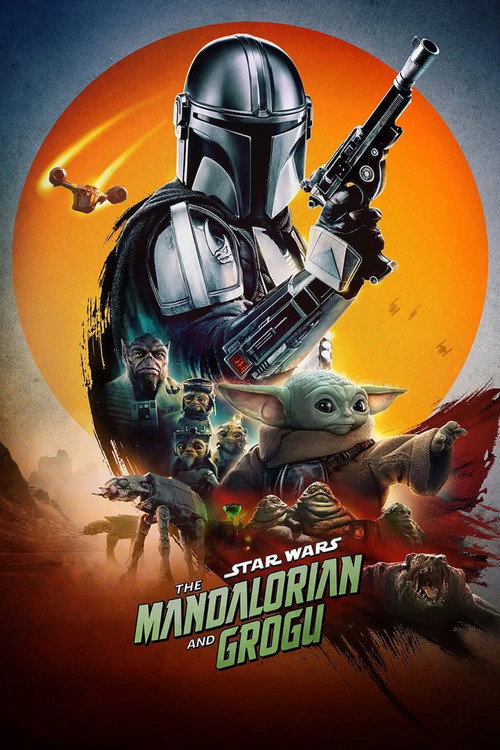
The Mandalorian and Grogu arrives with a strange burden and an even stranger relief: it is the first live-action Star Wars in theaters in seven years, and it is trying very hard not to be an event. Jon Favreau builds it the way he has said he builds everything, like a child moving action figures across a floor, and the result carries both the charm and the flatness of that instinct. Characters are picked up, aimed at a problem, and set back down. The film moves. Whether it goes anywhere is the question that divides the room.
Editorial Deep
Score breakdown, defended
Each dimension scores what it scores. The number is the claim; the prose is the defense.
Editorial Layer
Flat mean of the five dimensions below. Contributes 100% to the Skry Score.
The writing is built as task completion rather than consequence. Characters begin and end in the same emotional place, the plot advances by assignment rather than by choice, and it re-runs beats the series already established without building on them. The Nal Hutta stretch shows the script can reveal character through action with real economy, and that sequence is genuinely strong writing. But it is an island. The film also states its own theme aloud and then leans on it as structure, which reads as arranged rather than dramatized. The craft falters at its core intent of making a feature-scale story cohere.
The photography is clean, competently staged, and holds the larger IMAX frame without strain, which is a real baseline of professional craft. The limitation is expressive reach: the color and dynamism land below the series' own high points, the grading is muted, and the enclosed-space staging often works against the legibility of close-quarters combat. The single-take AT-AT sequence is the clearest evidence of confident visual authorship. Away from set pieces the image settles for adequacy rather than panache, which for a theatrical release is a real ceiling on the score.
Pascal delivers a believable, controlled performance inside armor that deliberately externalizes everything, and he anchors the film with steadiness even as the near-silence caps how much attachment the role can build. Grogu is the standout, carrying long wordless passages on physical behavior alone. Those two hold the center capably. The limitations sit at the margins: a colonel role written and played too thin to register, and a heavily modulated voice performance that draws attention to its processing rather than the actor. The leads accomplish what the film asks; the ensemble around them is uneven.
The film moves constantly, and that motion is its governing principle, so as a delivery system for kinetic sequences it often works. The oner and the salt-bar fight generate genuine snap. The problem is that movement is not the same as momentum: the episodic structure resets tension between set pieces, the action favors noise over building danger in its weaker stretches, and the standout arc disappears for long spans. The rhythm holds attention scene to scene while failing to accumulate across the whole. That unevenness is what keeps it from landing higher.
The Nal Hutta sequence rewards a second look; it is dense with behavioral detail and choreographed intent, and the oner is worth studying for how the camera and body share the work. Beyond those passages the architecture is thin by design. Task-completion plotting offers little to re-read, the themes are stated rather than layered, and characters who neither change nor deepen give a return viewing less to uncover. There are reasons to revisit specific scenes; there is less reason to revisit the film.
Favreau clearly loves this galaxy; affection, it turns out, is not the same as inspiration.
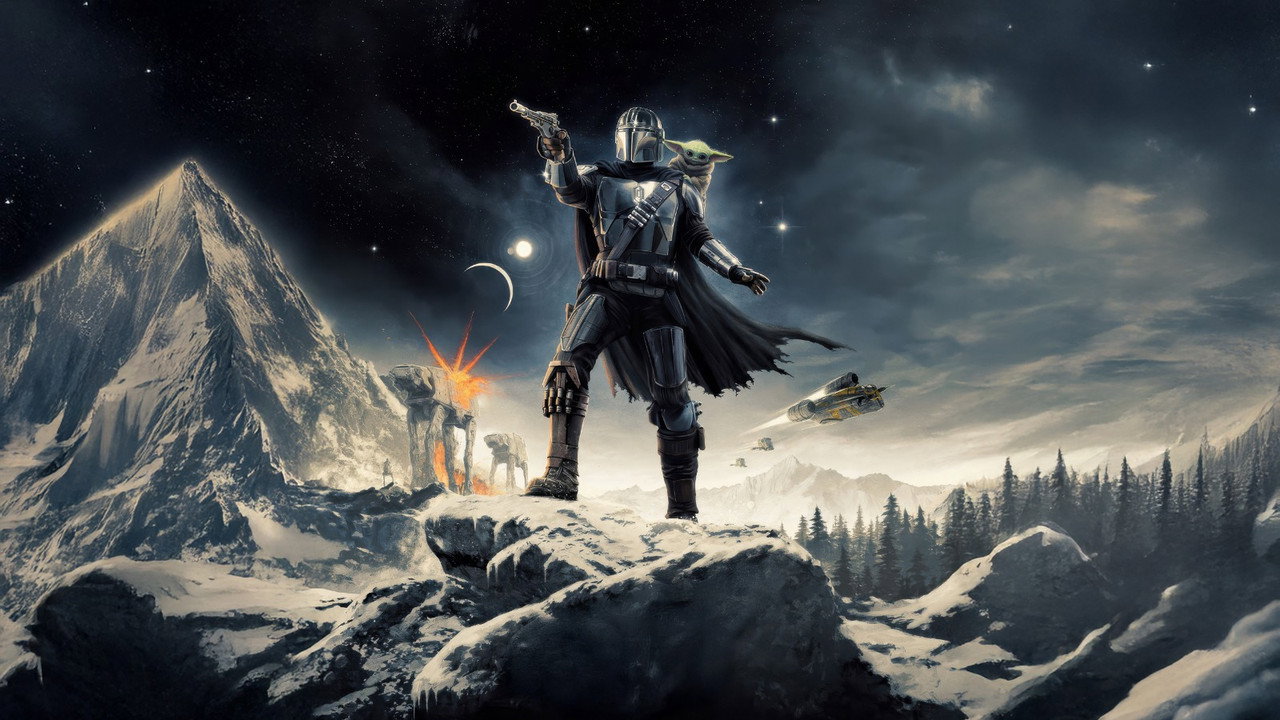
The construction is episodic by design. Favreau meets his hero mid-mission, borrowing the cold-open logic of the Bond and Indiana Jones pictures, and the opening pays that debt immediately. Grogu commandeers an AT-ST and scrambles up a snowbound slope; Mando boards an AT-AT to bring down a fleeing Imperial before the walker comes apart under them. A key stretch of it runs as a single unbroken take, built around Lateef Crowder's capoeira-trained physicality, the camera left to do the work while the body does the choreography. It is the most purely kinetic thing in the film, and it announces a movie that would rather show you motion than explain a stake.
The genuine standout comes later and quieter. On Nal Hutta, a poisoned Mando drops out of the action almost entirely, and for roughly fifteen near-silent minutes the film hands itself to Grogu: he builds a shelter from dirt, finds a walking stick, slips a bounty hunter, and secures a cure through a small act of kindness. No dialogue carries it. Character arrives through behavior. This is the register the rest of the movie only occasionally reaches, and it makes a persuasive case that the franchise's future might live in exactly this kind of patient, wordless sequence.
Elsewhere the action is more crowded and less legible. Favreau leans hard on Mando against CG creatures and droids in enclosed spaces, and that setting works against the reads a close-quarters fighting style needs. The gladiatorial dejarik match, in which Mando and Rotta brawl with life-size versions of the Falcon's holochess monsters, has real choreographic invention, particularly in Rotta's rolling, tail-swatting physicality. A salt-bar fight earns its place by inverting the character's usual lethality: Mando pulls his punches, subdues rather than kills, and the choreography does the work of showing you why. When the film fights to reveal intent, it is alive. When it fights to fill time, it thins out.
David Klein's cinematography is clean and competent without the color and dynamism the series established at its best, and it does not quite reach the visual weight a theatrical Star Wars invites. Roughly a third of the film was shot in full-frame IMAX, with sets built taller to hold the frame, though the expansion registers more as scale than as an expressive tool. Ludwig Göransson's score does what it reliably does, giving the movement a pulse and a grandeur the images sometimes withhold.
Pedro Pascal's Mando is solid and believable inside armor that keeps most of the acting external; the near-silence that has always defined the character makes attachment harder to generate across a feature's length. Grogu, given more to do and more agency than the series allowed, carries the film's best passages almost single-handedly. If the movie is inessential, and it may well be, it is at least honest about the modest thing it wants to be.
Beyond this line, spoilers
The Conversation
First-person welcome. Pushing back on consensus is a tool, not a formula.
Here is where the argument actually lives, because the reception splits cleanly and both sides have a point.
The case against is easy to state and hard to fully dismiss. Multiple readings land on the same verdict: this plays like several mid-season television episodes stitched into theatrical length, one going so far as to call it a mid-season filler episode where the characters end where they began. John Dougherty's framing sticks with me. Tom Jorgensen's version is sharper still: the film draws on effectively zero of the groundwork laid across three seasons, which makes it duplicative to anyone who watched them, and does so while re-running beats the series already covered. There is a structural complaint underneath both, that the plot is task completion rather than story, movement instead of escalation, with no choices that generate real consequence. I find that description accurate. The Nal Hutta sequence proves the film knows how to make behavior mean something, which makes the surrounding fetch-quest scaffolding harder to forgive.
And then there is the Sigourney Weaver problem. Kevin Pettit calls her Colonel Ward maybe the most checked-out performance of the decade, an NPC dispensing quest dialogue, and while that is brutal, the shape of the complaint tracks with how thinly the role seems written to function. Pettit also lands the harshest visual read: the film looks like television in the derogatory sense, flat grading and dull composition, to the point where he claims The Rise of Skywalker looks like Lawrence of Arabia by comparison. I would not go that far, but the loss of dynamism against the series' best is real.
The defense is more interesting than dismissal usually is. Jonathan Lack reads the modesty as the point: a necessary reset for a bloated landscape, a film admirably unburdened by the pressure of being the first Star Wars in seven years, the first live-action entry to simply accept that the franchise is no longer monocultural. There is something to this. The refusal to strain for event status is, in its way, a relief. Oliver Harper's counter is the one I keep returning to, though: three out of five, lively but inessential, stubbornly small in a storyline and themes that a seven-year gap should have outgrown. Whether small is a virtue or a failure depends entirely on what you think a theatrical Star Wars owes you, and the film does not settle that for you.
On the action, Ben Sherlock treats the movie as an effective action delivery system, sequences ranked from strong to exceptional, faults elsewhere notwithstanding. The opposing read calls the action scattershot, most sequences failing to build tension, movement without momentum and noise without danger. My own sense is that both are describing real footage. The oner and the salt-bar brawl belong to the first camp. The enclosed-space CG melees Jorgensen flags belong to the second, and there are more of the latter than the former.
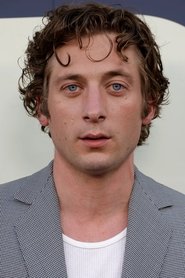
A few smaller notes. Jeremy Allen White's Rotta drew genuinely rough reactions, one calling the modulated voice work so processed that casting a prestige actor became pointless. Stephen Silver's observation cuts deeper: Rotta is described as the most compelling arc in the film yet vanishes for long stretches, which drains whatever weight the arc was meant to carry. Colin Scharff's roundtable enthusiasm for Göransson feels earned and about the only thing everyone agrees on.
The throughline the movie hands you out loud, the old protect the young and then the young protect the old, is delivered by Djarin himself after Nal Hutta. It is also the marketing frame. When a film states its meaning as dialogue and then repeats it as a tagline, you can feel the seams of something arranged rather than imagined. Favreau clearly loves this stuff, the creatures and gadgets and Western standoffs. Affection is not the same as inspiration, and this is a movie that mostly runs on the former.
Cast & Crew
Who made it, and who’s in it.
Cast

Pedro Pascal
The Mandalorian
Jeremy Allen White
Rotta (voice)

Sigourney Weaver
Colonel Ward

Brendan Wayne
The Mandalorian Suit Performer
Lateef Crowder
The Mandalorian Stunt Performer
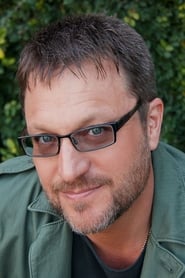
Steve Blum
Zeb Orrelios (voice)
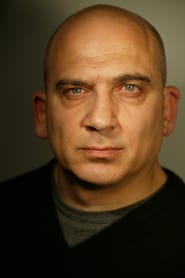
Jonny Coyne
Lord Janu
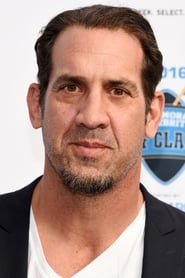
Matthew Willig
Hogsbreth
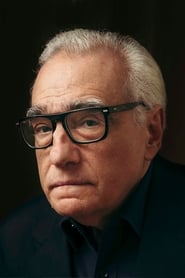
Martin Scorsese
Hugo Durant (voice)
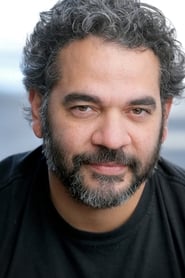
Hemky Madera
Commander Baro
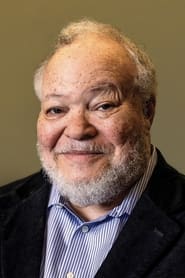
Stephen McKinley Henderson
Gatori (voice)

Shirley Henderson
The Anzellans (voice)
Crew
- DirectorJon Favreau
- Director of PhotographyDavid Klein
- EditorDylan Firshein
- Original Music ComposerLudwig Göransson
Trailer
Plays on YouTube, in a new tab.
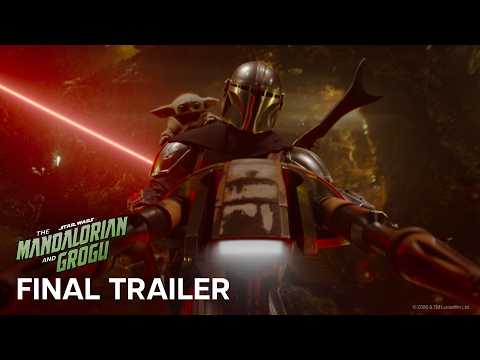 Final Trailer · 2026Watch on YouTube
 Reader response
About the Editor
Derik Silva
Editor-in-Chief
Derik founded The Skry to do for film and television what aggregator culture stopped doing — read closely, score honestly, and defend the score in writing. He believes the long arc is the only arc that matters: the films that earn their reputation by holding up over years, and the ones whose reputations have grown larger than the films can carry. Previously, he founded Travault.
The Skry Dispatch
Read closely, weekly. Reviews and dispatches from The Skry.