Film Review
The Odyssey
Matt Damon · Tom Holland · Anne Hathaway
Christopher Nolan opens his thirteenth feature not at sea, not in the wreckage of Troy, but inside the banquet hall at Ithaca, where a storyteller played by Travis Scott sets a tale in motion. The choice is telling. This is a version of Homer that begins further along than in medias res, then folds back on itself, and the folding is the point. Editor Jennifer Lame treats chronology less as a line than as a map, letting scenes recur with their meaning shifted by what we now know. The 173-minute runtime moves faster than its length; the structure keeps rearranging the ground beneath you.
Editorial Deep
Score breakdown, defended
Each dimension scores what it scores. The number is the claim; the prose is the defense.
Editorial Layer
Flat mean of the five dimensions below. Contributes 71% to the Skry Score.
The adaptation makes bold structural choices and commits to them: opening past in medias res, then unfolding a nonlinear architecture that treats chronology as revisitable rather than fixed. The transposition of the Trojan Horse from Virgil rather than Homer is a real interpretive move, not a cosmetic one, and it doubles as the film's argument for its own existence. The moral-metamorphosis arc built around Odysseus gives the writing a genuine spine. The limitation is emotional reach: a substantial critical camp finds the structural games engage the mind while leaving the heart at a distance, and that reading has enough support to keep the script from a higher mark.
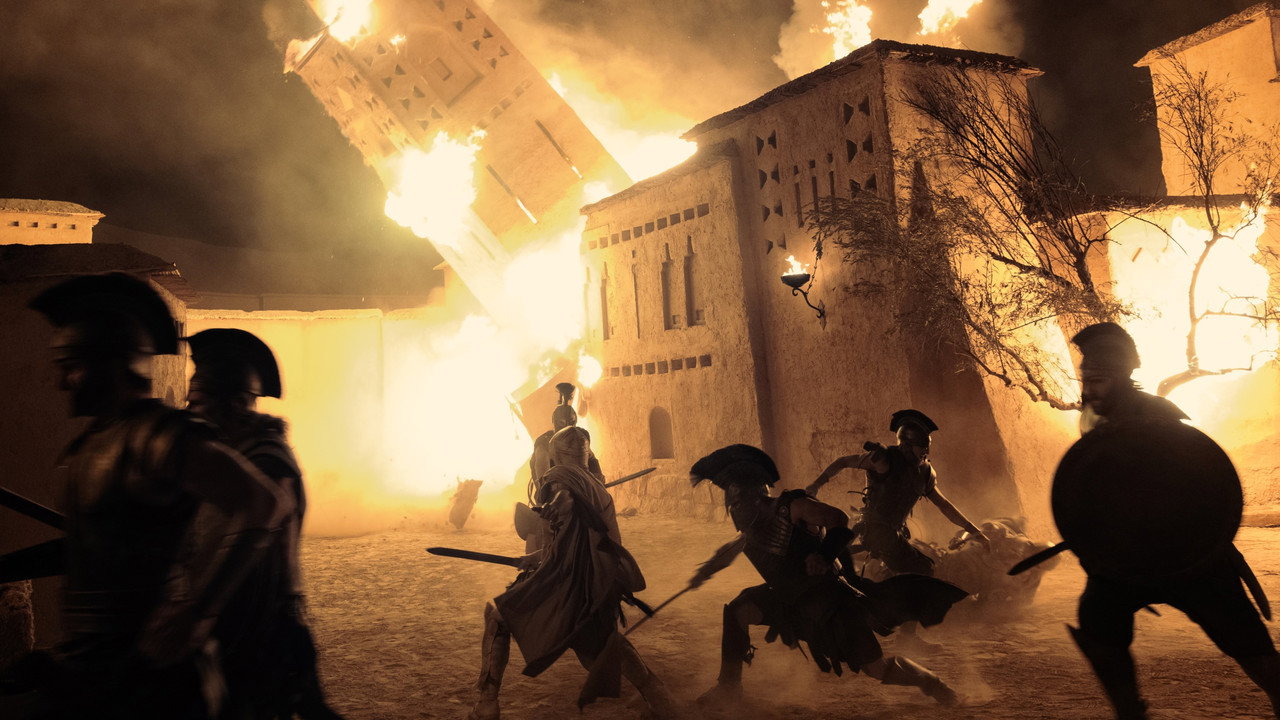
This is the film's most distinctive achievement and the case for it is unhedged. Shot entirely on IMAX film, a first for a commercial feature, the image delivers a tactility digital cannot match: the sea, the blood, the physical weight of a thirty-meter structure collapsing around live performers. The Trojan Horse reimagining and the finale demonstrate a single-unit discipline that keeps one point of view across every set piece. The command of scale and the sensory density are the defining reasons the film registers as a watershed in large-format production. The craft here is not merely achieved but memorable.
Damon delivers a career-peak performance, ideally cast, with the finale as its physical and dramatic apex; the film builds a structure around his likability and then pressures it, and he carries that design. The ensemble is deep and repeatedly praised. The honest limitation is the Telemachus performance, the single most contested element, where restraint reads as maturity to some and blankness to others. That live division keeps the dimension below the exceptional band while the strength of the lead and the surrounding cast hold it well above competent.
A 173-minute epic that consistently plays shorter than its length, driven by editing that revisits moments with shifting significance and by a set-piece cadence delivering spectacle at close intervals. The momentum is real and sustained. The counterweight is the recurring charge that the film thrills without fully moving, plus dialogue audibility problems that intermittently break immersion. The rhythm is confident and the feeling largely lands; the emotional-cool critique is what holds it just under the top tier.
The nonlinear architecture is built for return: scenes recharge with meaning once the full map is visible, in the manner of Memento but at epic scale. The veterans-unable-to-return subtext offers a second layer that rewards a viewer who already knows the shape. The density of the practical imagery and the weaponized-likability design of the lead performance both reveal more on a second pass. This is a picture with genuine architecture underneath the spectacle, and the reasons to go back are structural rather than incidental.
The format is not decoration here; it is the whole argument about what a screen this size can do to a body watching.
The first thing to say about the image is that it is unlike anything Nolan has put on a screen before, and the technical means are inseparable from the effect. Shot entirely on IMAX film, the movie carries a tactility that digital capture does not reproduce. You register the sea, the congealing blood, the weight of bodies. The Trojan Horse arrives as a genuine reinvention: half-buried in shallow water, dragged up the beach on rolling logs by men straining under its mass, Greek warriors packed inside for days alongside their own dead. It reads as a mission statement about looking at old stories with fresh eyes. A Trojan War flashback stages a burning structure roughly thirty meters high collapsing around live stunt performers, and the heat and impact land with the force of documentary rather than effect. Nolan shoots his action with a single unit and no second-unit handoff, on the logic that ceding the set pieces would compromise his point of view across the whole film. The consistency shows.
Matt Damon anchors all of it, and the casting is close to ideal. His familiar likability is the instrument here, deployed easily at first and then progressively pressured, so that the affection an audience brings to him becomes something the film interrogates rather than rewards. The finale, an extended hand-to-hand sequence, is both the physical and dramatic peak of the performance and among the strongest set pieces of Nolan's career. The ensemble around him is deep. If there is a live question in the reception, it concerns Tom Holland's Telemachus, which has divided viewers sharply between those who read his earnestness as a genuine coming-of-age arc and those who find the interpretation too close to a screen persona they already know. I lean toward the former, though the debate is real and worth having.
One caution, familiar to anyone who has followed this director: dialogue audibility is inconsistent, and in places the sound mix buries lines under everything else it prioritizes. And there is a larger fault line running through the response to the film, which is whether all this spectacle moves you or only occupies you. The picture is vast and frequently dazzling. Whether the heart travels with the eyes and ears is the question worth carrying into the theater, and I take it up more directly in the open zone below.
A practical note. Only 41 theaters worldwide, and 25 in the United States, can project the film in its intended 1.43:1 IMAX 70mm ratio. If you can reach one of them, the difference is not academic. This is a movie built at that scale and cropped away from it at real cost.
Beyond this line, spoilers
The Conversation
First-person welcome. Pushing back on consensus is a tool, not a formula.
I want to sit with the central disagreement, because it is the most interesting thing about the film's reception. Guy Lodge, who is generous about the scale and calls the vision genuinely grand and gutsy, also lands the sharpest reservation: that the picture keeps the eyes, ears, and mind lavishly occupied while never quite becoming moving. Homer, in his phrase, is where the heart is not. Against that you have a chorus reading it as overwhelming both visually and emotionally, and Clarisse Loughrey championing it as the film that defines Nolan, a breathtaking epic of men, monsters, and moral metamorphosis. Both camps are watching the same movie. I think the split is real and I don't think it resolves cleanly, but here is where I come down: the Damon performance is the emotional engine, and it works precisely because of the weaponized-likability structure. The film spends its charisma early and then makes you pay attention to the moral costs that charisma was hiding. If you meet that on its terms, the feeling arrives late and lands hard. If you're waiting for the epic to warm you the way a smaller drama would, you'll feel the cool that Lodge describes.
The Telemachus question is the other one I keep turning over. Gregory Nussen reads Holland's work as his strongest to date, full of quiet conviction. Stephanie Zacharek finds him nearly unreadable, and someone else's line about Peter Parker in a tunic has clearly stuck. I don't think the performance is bland. I think the film asks Holland to play restraint against Damon's fully mobilized presence, and restraint next to that reads as blankness to some viewers and as maturity to others. It's a legitimate directorial risk that produces a legitimately divided result.
On craft, the near-unanimity is almost its own problem. When Malcolm McMillan gives it five stars and says the only weakness is that everything is so uniformly excellent nothing stands out, he's paying a compliment that shades into a real observation. Nick Newman's dissent, that the pure-IMAX method is a 1.43:1 monument to itself and a tantalizing concept that doesn't bear fruit, is the minority craft report worth taking seriously, even if I disagree with it. Matt Zoller Seitz makes the stronger case: the analog production is what puts you physically inside the action, and the burning-building collapse is the proof. I find that more persuasive than the monument charge. The format is not decoration here. It's the whole argument about what a screen this size can do to a body watching.
The structure earns a comparison to Memento, and I buy it. This is disordered time as the primary storytelling device, not a flourish, closer to Penelope weaving and unweaving than to a gimmick. Whether it's Nolan's most experimental work since then, I'd want to argue over a drink, but it's not a lazy comparison.
One last thread. Several readings frame Odysseus's twenty-year drift as a metaphor for soldiers who can't come home from a long war of choice, with the monsters standing in for addiction, trauma, and the pull of communal grief. I'm wary of mapping the creatures too neatly onto a checklist. But the veterans-unable-to-return subtext is genuinely there, and it's the part of the film most likely to keep working on you after the spectacle recedes. That, more than the Trojan Horse, is where I'd start a second viewing.
Cast & Crew
Who made it, and who’s in it.
Cast

Matt Damon
Odysseus
Tom Holland
Telemachus

Anne Hathaway
Penelope

Robert Pattinson
Antinous
Himesh Patel
Eurylochus

John Leguizamo
Eumaeus

Charlize Theron
Calypso

Travis Scott
Bard

Corey Hawkins
Polybus
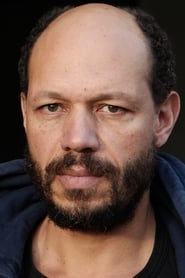
Jarreth J. Merz
Leodes
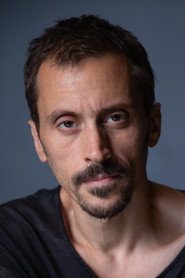
Niko Nicotera
Peisander

Elliot Page
Sinon
Crew
- DirectorChristopher Nolan
- Director of PhotographyHoyte van Hoytema
- EditorJennifer Lame
- Original Music ComposerLudwig Göransson
Trailer
Plays on YouTube, in a new tab.
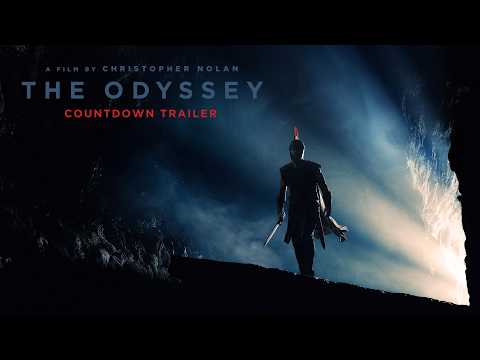 Official Countdown Trailer · 2026Watch on YouTube
 Reader response
About the Editor
Derik Silva
Editor-in-Chief
Derik founded The Skry to do for film and television what aggregator culture stopped doing — read closely, score honestly, and defend the score in writing. He believes the long arc is the only arc that matters: the films that earn their reputation by holding up over years, and the ones whose reputations have grown larger than the films can carry. Previously, he founded Travault.
The Skry Dispatch
Read closely, weekly. Reviews and dispatches from The Skry.