TV Review
House of the Dragon
Matt Smith · Steve Toussaint · Sonoya Mizuno
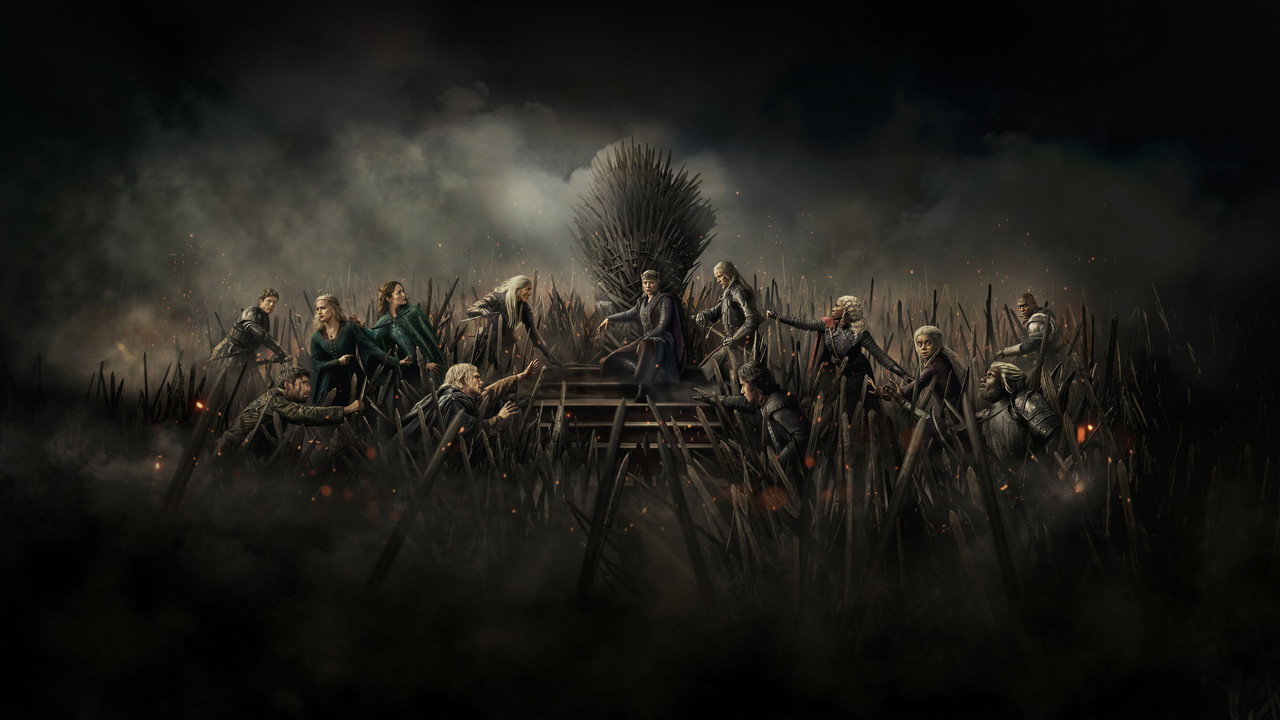
House of the Dragon arrives with a specific inheritance to manage: it is the first major extension of a franchise that ran aground in public, and its opening gambit is to make you feel at home before it changes the locks. Jim Clay's production design does the diplomatic work first. The Red Keep is built as a topographically accurate, four-wall soundstage in Watford, with corridors physically joined to the rooms they connect, and that solidity is not decoration. It lets the camera travel for real. Loni Peristere and others exploit this with extended, unbroken takes, the most celebrated of which follows Rhaenyra up the grand staircase after childbirth in a single ten-minute move that never cuts away from the labor of the moment. The set is designed to press on the people inside it. Statues of dead kings loom permanently over whoever sits the throne, and small choices carry weight: a desk placed in what had been a male domain reads as a claim staked in furniture.
Editorial Deep
Score breakdown, defended
Each dimension scores what it scores. The number is the claim; the prose is the defense.
Editorial Layer
Flat mean of the five dimensions below. Contributes 71% to the Skry Score.
The writing achieves its central aim: a dynastic court tragedy that refuses easy heroes and, at its peak, produces dialogue rivaling the series' best speeches, including a Season 3 monologue that dismantles a character with forensic precision. The moral clarity of the 'everyone grasping' register is a choice executed on purpose, not by accident. The limitation is consistency. The connective scenes between the strong set pieces occasionally reach for effect and land on anachronism, and the sustained 'everyone sucks here' mode taxes the empathy the tragedy depends on. Solid, purposeful, uneven at the seams.
The image is where the show operates at full command. A topographically accurate Red Keep built with physically joined corridors turns extended real camera moves into structural design rather than showmanship: the ten-minute unbroken staircase walk after childbirth is a genuine craft achievement, and the throne room's looming statues do thematic work through composition. Daemon's torchlit approach to Vermithor uses near-darkness to establish scale better than any lit spectacle could. The one honest reservation is a periodic cleanliness in the lighting that can feel too soft for a story this cruel. The command of built space and camera movement is distinctive and memorable.
The ensemble carries the narrowed world convincingly. Emma D'Arcy has grown more exact as the role darkened, giving the show a still center; Matt Smith works a register of hammy menace that stays watchable without collapsing into camp. Sonoya Mizuno and Phoebe Campbell strengthen as their screen time expands, and the cast consistently treats power as a human problem rather than a plot function. The limitation is not performance but legibility: the deliberate silver haired uniformity of the family means the actors are often fighting to individuate characters the design has made visually similar. They mostly win that fight.
The show moves best in its set pieces, where the Battle of the Gullet fuses spectacle and grief without losing the human cost, and the quiet peaks like the Season 1 family dinner land with real weight. When it's on, the momentum is confident. The limitation is the trough between peaks: the pacing sags in the connective passages, and a mode that withholds comfort as a matter of principle can read as attrition rather than tension over long stretches. The rhythm achieves its aims in bursts and drifts in between.
There is genuine architecture to return to. The production design rewards a second pass, from the desk in Rhaenyra's chambers to the kings looming over the throne, and the built set makes the long takes worth studying for construction alone. The Larys monologue and the Gullet reward rewatching for craft. What caps it is the unevenness that keeps some stretches from earning revisitation, and a design uniformity that can flatten the ensemble on return. Dense where it counts, thinner in the gaps.
A chamber piece with dragons, built by people at the top of the medium and undone, when it stumbles, by the scenes between the spectacle.
This is a series that has deliberately narrowed its aperture. Where its predecessor sprawled across continents and mythologies, this one stays inside one dynastic family and its court, dialing down the supernatural in favor of succession, alliance, and the slow rot of a house at war with itself. The result is a chamber piece with dragons, and the dragons are used sparingly enough to keep their scale terrifying. Daemon's torchlit song to Vermithor, glimpsed in near total darkness, tells you more about what a dragon is than any daylight flyover could.
The casting is where the narrowing pays off. Emma D'Arcy anchors the show's later reaches with a performance that has grown more precise as the role has darkened; Matt Smith works a register of cheerful menace that keeps threatening to tip over and mostly doesn't. Around them, Sonoya Mizuno and Phoebe Campbell gain force as their screen time expands, and the ensemble's silver-haired uniformity is both a design principle and, at times, a legibility problem the show has to keep solving.
The craft is not in dispute; the shape of the thing is. This is a court drama that asks you to invest in a room full of people who are, by design, hard to root for, and the quality of the writing that populates that room varies. At its best the dialogue rivals the finest speeches of the first season. At its weakest it reaches for effect and lands on anachronism. What holds it together is the physical world it moves through and a cast that treats the machinery of power as a human problem rather than a diagram. It looks, occasionally, too clean for a story this cruel. But when the set pieces land, they fuse spectacle to grief in a way the genre rarely manages.
Beyond this line, spoilers
The Conversation
First-person welcome. Pushing back on consensus is a tool, not a formula.
Let me open the doors, because the interesting argument about this show is not whether it's well made. It plainly is. The argument is about what it's for, and whether it has stayed loyal to the thing it adapted.
Start with the split verdict, because it's real and it won't resolve. Critics have trended warmer as the show has gone on. Roxana Hadadi makes the strongest version of that case, arguing the series fixed its momentum problem after a slack second season and reached its peak in Season 3: bleak, clear eyed, no longer in love with the people clawing for power. The audience number tells a different story. A user score of 5.8 against a much higher critic consensus is not noise. A meaningful chunk of the people watching believe the show peaked in Season 1 and has thinned out since. I don't think either camp is lying. They're valuing different things. If you came for the granular pleasure of an ensemble you'd die for, the show's deliberate 'everyone sucks here' register is genuinely exhausting; that dissent is worth taking seriously, and it's the sharpest knock against the whole enterprise. If you came for a court tragedy that refuses to hand you a hero, the same quality reads as nerve.
Then there's the George R.R. Martin problem, which hangs over everything now. Sapochnik and Condal ran the show together at first. Sapochnik directed the premiere and the most ambitious hours of Season 1, then left, and Martin has been publicly unhappy about the direction ever since. The now deleted 'this is not my story any longer' line is the kind of thing you can't unhear once you know it. Eva Sheahan's critique of shallow dialogue and arbitrary scenes fits into that frame, and a specialist reading of Season 3 argues its individually fascinating elements never feel fully thought through in the larger design. When the author who invented these deaths says the adaptation has drifted, and Martin's whole method is killing characters rather than protecting them, you have to at least ask whether the show still has that discipline.
And yet. The Battle of the Gullet is the counterargument in one sequence. Jarrod Jones is right that it makes good on the promise the show has been writing checks against for years, folding family tension into dragon warfare without losing sight of who dies and what it costs them. Erik Kain singles out a Season 3 monologue where Larys Strong forensically takes Aegon apart and calls him a terrible man, and it does rival the best of Viserys in Season 1. Those are not the beats of a show coasting.
My own read: the ceiling here is very high and the floor is lower than the ceiling should allow. The single take staircase walk and the Vermithor scene are the work of people operating at the top of the medium. The wobble is in the connective tissue, the scenes between the set pieces where the writing occasionally reaches for a line it hasn't earned. Cernjul's approach of letting scenes discover themselves over hours of rolling the unscripted Rhaenyra and Mysaria kiss came out of that produces some of the show's most alive moments and probably some of its loosest. That's the trade.
Two Emmys, 23 wins, over a hundred nominations. The industry has decided. The audience is still arguing. I land closer to the critics than the crowd, but I understand the crowd, and I think a show this committed to withholding comfort was always going to earn a divided house.
Cast & Crew
Who made it, and who’s in it.
Cast
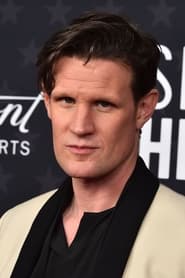
Matt Smith
Prince Daemon Targaryen

Steve Toussaint
Lord Corlys 'The Sea Snake' Velaryon
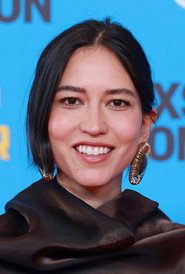
Sonoya Mizuno
Mysaria 'The White Worm'
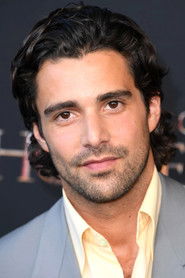
Fabien Frankel
Ser Criston Cole

Matthew Needham
Lord Larys 'Clubfoot' Strong

Emma D'Arcy
Princess Rhaenyra Targaryen

Kurt Egyiawan
Grand Maester Orwyle
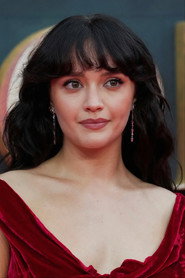
Olivia Cooke
Queen Alicent Hightower

Jefferson Hall
Lord Jason Lannister / Ser Tyland Lannister
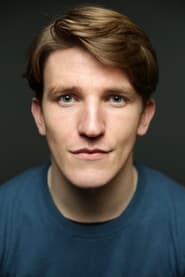
Ewan Mitchell
Prince Aemond Targaryen
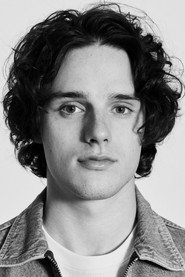
Harry Collett
Prince Jacaerys 'Jace' Velaryon
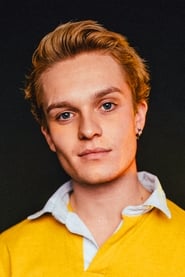
Tom Glynn-Carney
King Aegon II Targaryen
Crew
- CreatorGeorge R.R. Martin
- CreatorRyan J. Condal
- DirectorClare Kilner
- DirectorGreg Yaitanes
- DirectorGeeta Patel
- DirectorMiguel Sapochnik
- DirectorLoni Peristere
- DirectorNina Lopez-Corrado
- DirectorAlan Taylor
- DirectorAndrij Parekh
- Director of PhotographyAlejandro Martínez
- EditorCrispin Green
- Original Music ComposerRamin Djawadi
Trailer
Plays on YouTube, in a new tab.
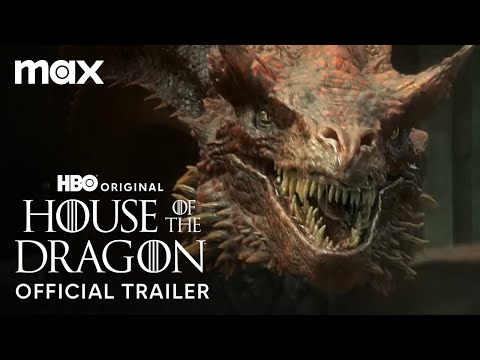 Official Trailer · 2022Watch on YouTube
 Reader response
About the Editor
Derik Silva
Editor-in-Chief
Derik founded The Skry to do for film and television what aggregator culture stopped doing — read closely, score honestly, and defend the score in writing. He believes the long arc is the only arc that matters: the films that earn their reputation by holding up over years, and the ones whose reputations have grown larger than the films can carry. Previously, he founded Travault.
The Skry Dispatch
Read closely, weekly. Reviews and dispatches from The Skry.