
TV Review
Ted Lasso
Jason Sudeikis · Hannah Waddingham · Jeremy Swift
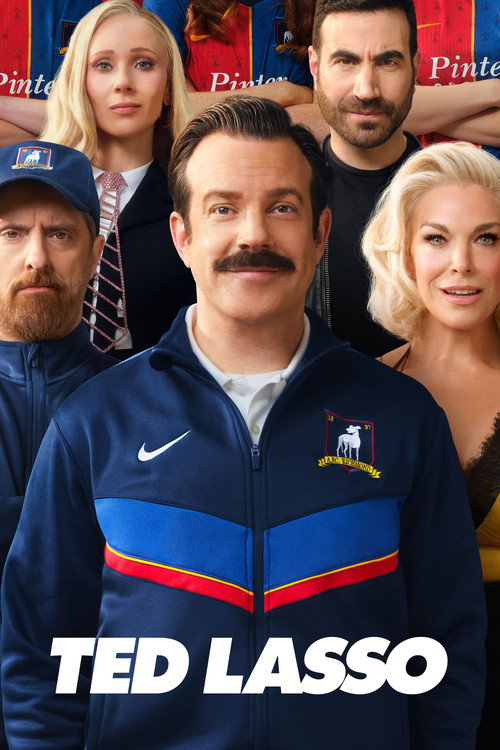
Ted Lasso opens with a man walking into a job he is unqualified for, and it never pretends otherwise. In the pilot's press conference, the newly installed manager of AFC Richmond cheerfully confesses he has never coached the sport the English call football at any level, then fumbles the vocabulary of the game by counting off four quarters. The scene does two jobs at once. It establishes the fish-out-of-water premise cleanly, and it locates the show's real subject not in Ted's incompetence but in his disarming awareness of it. That awareness is the engine. Jason Sudeikis, coming off a career built in sketch and film comedy, strips the character of the loud American cliché he could have leaned on and replaces the noise with an almost defiant warmth.
Editorial Deep
Score breakdown, defended
Each dimension scores what it scores. The number is the claim; the prose is the defense.
Editorial Layer
Flat mean of the five dimensions below. Contributes 71% to the Skry Score.
The writing achieves a genuinely difficult tonal balance: it converts a broad fish-out-of-water premise into an ensemble machine where Ted functions as an entry point to fully rendered supporting characters rather than a hero who dominates. The best structural moves are reversals staged physically rather than spoken, and the show handles a suicide-driven dramatic pivot without capsizing its comic register. The honest limitation is durability across the full run: the comedy thins in places, at least one stretch sacrifices its laughs for character work, and the final season's arcs frame themselves as bloated and self-parodic. The core mission holds; the reach falters late.
The image is a considered rejection of network-comedy flatness. Large-format capture with a clean, bright, saturated palette gives the show a filmic body, and the choice to run single-camera handheld even under multi-camera coverage produces a restless, observational quality that keeps the comedy grounded rather than staged. The dressing-room standing set is a real piece of production-design intelligence, compressing football logistics offscreen to keep the frame on faces. The de-realized visual language built for the panic sequences is a specific, developed craft solution rather than a generic effect. This is confident, purposeful camerawork operating well above genre baseline.
Sudeikis carries the show by refusing the loud version of the character, trading American caricature for a committed, charismatic warmth that anchors every scene without swallowing it. The design of the ensemble as fully realized figures gives Waddingham, Temple, Goldstein, and Dunster room to build people rather than foils, and the acclaim is broadly consistent about the cast's sustained excellence across seasons. The one line of dissent finds the central character underwritten in the earliest going, which reads more as a first-season calibration than a performance failure. The listening-centered cutting is built to showcase reaction acting, and the ensemble repeatedly delivers it.
The show moves on a reliable rhythm of setup, warmth, and emotional payoff, and its cutting logic, holding on the listener rather than the punchline, gives the beats a distinctive tempo that lands feeling over gag. The Season 2 dramatic pivot demonstrates the series can shift gears into real weight and sustain it. The limitation is momentum over distance: the comedy runs sporadic in stretches, and the final season is widely felt as an endurance test with bloated episode lengths that slacken the pace the earlier seasons kept taut. Strong beat-to-beat feeling; uneven across the marathon.
The reason to return is the density of small human turns rather than plot mechanics, and that density rewards a second pass: the ensemble architecture reveals how carefully each supporting figure is seeded and paid off, and set pieces like the bike-riding reversal work as compressed character essays. The prescriptive, cathartic structure is built to be re-experienced for feeling rather than decoded for information. The limitation is that the later material re-colors the whole on rewatch for some viewers, and the interpersonal-only resolution leaves less systemic texture to mine than a denser prestige serial would. Solid architecture, more emotional than forensic.
Meet it on its own terms — prescriptive, cathartic, unashamed of its decency — and most of it earns the affection it asks for.
What keeps the premise from thinning is the show's refusal to treat Ted as its hero. He works better as a door into the people around him. Hannah Waddingham's club owner, Juno Temple's model-turned-confidante, Brett Goldstein's granite-jawed veteran, Phil Dunster's preening striker: each is given room to become a full figure rather than a foil, and the writing rewards the patience it asks for. The best sequences run on reversal. When Roy learns to ride a bike alongside Jamie, the scene works almost wordlessly, staging mutual growth as a shift in physical power rather than a speech about it. When the philosophy sharpens into competition, as in the much-cited dart sequence, Ted's folksiness turns suddenly, satisfyingly hard.
The look supports the tone with more deliberation than the genre usually gets. Shot on large-format cameras since the pilot, the image is clean, bright, and saturated, built pointedly against the flatter conventions of network comedy. The camera stays largely single-camera and handheld even when it needs multiple angles to cover the action, which gives the whole thing a restless, observational feel rather than a staged one. The cutting follows the same logic. The editing prioritizes reaction over punchline, holding on the listener so that the emotional weight of a line lands on the face receiving it. The AFC Richmond dressing room, with its taped-up 'Believe' sign, sits at the center of every episode as a standing set, a smart compression that keeps the football logistics offstage and the human business front and center.
The show is not evenly great across its run, and it would be dishonest to sell it as such. Its comedy is the department most exposed to weakness. The jokes can go sporadic, and at least one stretch trades most of its laughs to make room for character work. But the aim is legible and mostly met: a series about good-natured perseverance, about staying decent in the face of indecency, built for people who want a controlling idea and a cathartic shape rather than a puzzle to solve. On that intent, it delivers with unusual consistency.
Beyond this line, spoilers
The Conversation
First-person welcome. Pushing back on consensus is a tool, not a formula.
Now I can talk about where this goes and why I keep circling back to it.
The show's reputation is not one clean line, and pretending otherwise does it a disservice. Season 1 earned a strong critical footing, Season 2 climbed to the show's critical high, and Season 3 dropped notably amid a real consensus that the episodes had bloated and the arcs had frayed. That last season splits people hard. James Hibbs went so far as to call it the finest series to come from its platform, praising the ensemble's sustained work and the assured strength of the opening episodes. Against that, a substantial body of writing framed Season 3 as an endurance test, singling out the labored comedy and the 'Led Tasso' alter-ego bit as evidence the show had begun parodying itself. Both can be true at once. Season 3 is where the machine strains, and where a viewer's tolerance for the show's core mode gets tested rather than rewarded.
The deeper argument, the one I find most useful, is about whether Ted's optimism is a genuine virtue or a structural evasion. Alexander Hudson Beare and Robert Boucaut make the sharp version of the case: that Ted's kindness operates only at the interpersonal level, never touching the institutional machinery of professional football, and that this vagueness sits comfortably with a corporate identity. It is a real critique and worth sitting with. The show does resolve almost everything at the level of the individual heart. But I think the counter-case holds more than the critique allows. Researchers describing the series as countercultural are onto something concrete: it plants empathy and emotional openness in the locker room and the coaching office, spaces built on dominance narratives, and it treats that as the whole point rather than a subplot. Whether you read that as brave or as tidy depends on what you want fiction to do.
The emotional weight is not evenly distributed, and the show knows where its heaviest hour lives. The Season 2 episode in which Ted confronts his father's death by suicide is the one repeatedly credited with convincing skeptics the series could carry serious dramatic weight. It works because the show had already built a visual grammar for Ted's panic attacks, drawing on Sudeikis's own detailed description of the physical experience, twitching fingers and shifting senses, and finding a de-realized approach rather than a literal one. That episode is the pivot on which the whole enterprise turns from likable comedy into something with real stakes.
I want to take the David B Morris argument seriously too, because it is the one that lingers. His case is that the show's Emmy dominance owes less to intrinsic quality than to timing: it arrived during lockdown, at the end of the Trund administration, in a year when Veep, Schitt's Creek, and The Good Place had all just exited, leaving an awards vacuum it walked into. And once Season 3 disappointed, critics started retroactively asking whether it had ever been great. There is something to the vacuum theory. But timing explains why a show gets rewarded, not why it gets watched twice, and the density of genuinely affecting scenes is not an accident of the calendar. Melanie McFarland's line about the show being an encrusted splendor if its moments were gems overstates it a little, but it points at the truth: the reason to return is the accumulation of small human turns, not the plot mechanics.
My honest position lands between the champions and the skeptics. The first two seasons do something difficult with real craft. The third strains at the seams and gives the doubters their ammunition. If you go in expecting a masterpiece and stay for the wobble, you will feel the disappointment the consensus describes. If you meet it on its own terms, as prescriptive, cathartic, unashamed of its own decency, most of it earns the affection it asks for.
Cast & Crew
Who made it, and who’s in it.
Cast
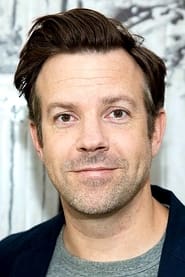
Jason Sudeikis
Ted Lasso
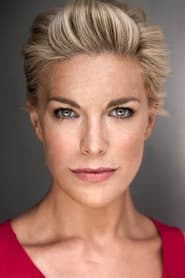
Hannah Waddingham
Rebecca Welton

Jeremy Swift
Leslie Higgins

Brett Goldstein
Roy Kent

Brendan Hunt
Coach Beard

Juno Temple
Keeley Jones

Phil Dunster
Jamie Tartt

Nick Mohammed
Nathan Shelley
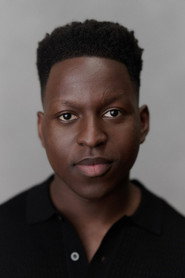
Toheeb Jimoh
Sam Obisanya
Kola Bokinni
Isaac McAdoo
Billy Harris
Colin Hughes

Stephen Manas
Richard Montlaur
Crew
- CreatorJason Sudeikis
- CreatorBill Lawrence
- CreatorBrendan Hunt
- CreatorJoe Kelly
- DirectorDeclan Lowney
- DirectorMJ Delaney
- DirectorErica Dunton
- DirectorMatt Lipsey
- DirectorTom Marshall
- DirectorDestiny Ekaragha
- DirectorEllie Heydon
- DirectorElliot Hegarty
- DirectorEzra Edelman
- DirectorSam Jones
- DirectorZach Braff
- WriterDylan Marron
- Director of PhotographyDavid Rom
- EditorMelissa McCoy
- Original Music ComposerMarcus Mumford
Trailer
Plays on YouTube, in a new tab.
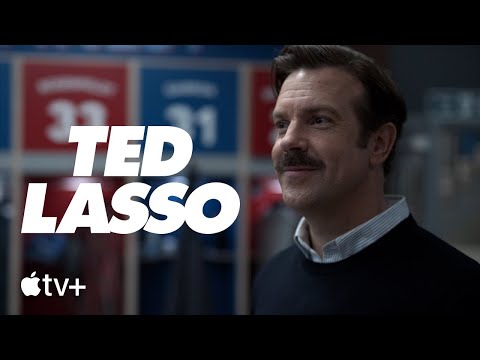 Official Trailer · 2020Watch on YouTube
 Reader response
About the Editor
Derik Silva
Editor-in-Chief
Derik founded The Skry to do for film and television what aggregator culture stopped doing — read closely, score honestly, and defend the score in writing. He believes the long arc is the only arc that matters: the films that earn their reputation by holding up over years, and the ones whose reputations have grown larger than the films can carry. Previously, he founded Travault.
The Skry Dispatch
Read closely, weekly. Reviews and dispatches from The Skry.